Showing posts with label Michael Thomas Barry. Show all posts

Monday, November 29, 2021

Review of Fear No Evil by James Patterson


Author: James Patterson

Release Date: November 22, 2021

Publisher: Little Brown & Company

Buy from Amazon: https://www.amazon.com/Fear-No-Evil-Alex-Cross/dp/0316499145/ref=sr_1_2?keywords=james+patterson&qid=1638212199&qsid=137-0792672-2832115&sr=8-2&sres=0316499145%2C0759554269%2CB08W529Q23%2C0316499374%2C0316276626%2C0316499870%2CB09L82GKQX%2C1538752832%2C1538718855%2CB08WRNPF3M%2C1538715457%2C0316499447%2C0316540714%2C1538703556%2C1529125871%2CB08Y8ND73G%2C1538703939%2C075955434X%2C0316499773%2C1538703548

Alex Cross ventures into the rugged Montana wilderness where he will be the prey. He's not on the job, but on a personal mission—until he's attacked by two rival teams of assassins, controlled by the same mastermind who has stalked Alex and his family for years. Darkness falls. The river churns into rapids. Shots ring out through the forest. No backup. No way out. Fear no evil.

“Someone had dipped a rolled-up section of that morning’s Los Angeles Times in the blood pooled on the floor and used it to scrawl these words on the wall . . . Las Familias Muertas No Cuentan Cuentos . . . Dead families tell no tales . . .”

This is the 29th installment of bestselling author James Patterson’s wildly successful Alex Cross thriller series. Patterson is known as the world’s bestselling author and has created more enduring fictional characters than any other novelist living today. The Alex Cross series was first published in 1993 with Along Came a Spider.

The main protagonist in the series, Alex Cross, is a highly intelligent and rational detective and specialist in forensic psychologist based in Washington, D.C. He started as a homicide detective but eventually becomes a senior agent with the Federal Bureau of Investigation. During the series, he eventually returns to private psychology practice but continues to work with the local police department as needed. Each novel contains an entirely new plotline, however, there are references to prior narratives in each new novel.

Fear No Evil is somewhat unusual in that Cross and his associates find themselves caught in the crosshairs of two warring drug cartels. They are pulled into a case where the body count rises precipitously. Cross, et al, soon become the targets for both groups, and they end up in the wilds of Montana.

“I want someone who can help me understand the situation enough to halt the needless killing. . . . You do know that you can never stop that kind of violence, Señor Cross. I’ve spent my whole life in it. Never once stopped. Oh, maybe a week here, a week there. But violence, fighting for what’s yours, building an empire, becoming as king—that is the natural course of life. How are you going to stop life doing its violent things?”

Throughout the entirety of the Alex Cross series, Patterson has consistently included the strong bond of friendship and love, and this continues with Fear No Evil. Cross is still the supportive husband to Bree and a good friend and longtime partner to John Sampson, always there in their times of need.

Kudos to Patterson for creating yet another exciting chapter in the Alex Cross saga. A master of his craft, Patterson slowly builds the plot with a series of set pieces, well-timed reveals, and a final twist that climaxes in a heart-pounding and tense ending. Fear No Evil is a compelling and captivating read. A sure-shot bestseller. An action-packed suspense-filled crime thriller that will have you racing through every page. A must-read for all James Patterson and Alex Cross fanatics.

This review first appeared at the New York Journal of Books on November 28, 2021 - https://www.nyjournalofbooks.com/book-review/fear-no-evil-alex

Wednesday, November 3, 2021

Review of Stranger in the Lifeboat by Mitch Albom


Author: Mitch Albom

Release date: November 2, 2021

Publisher: HarperCollins

Buy from Amazon: https://www.amazon.com/Stranger-Lifeboat-Novel-Mitch-Albom/dp/006288834X/ref=asc_df_006288834X?tag=bingshoppinga-20&linkCode=df0&hvadid=80814219495561&hvnetw=o&hvqmt=e&hvbmt=be&hvdev=c&hvlocint=&hvlocphy=&hvtargid=pla-4584413749017390&psc=1

Acclaimed author Mitch Albom has penned five consecutive #1 New York Times bestselling novels. His books have sold nearly 33 million copies and have been translated into 42 different languages worldwide. Known for finding spiritual meaning in everyday life with novels such The Five People You Meet in Heaven, The Next Person You Meet in Heaven, and The First Phone Call from Heaven, Albom in his writings often seeks to answer the meaning between the divine state and experiences bounded by physical reality.

“It’s been three days since the Galaxy sank. No one has come looking for us. I try to stay positive . . . I see surrender in the eyes of many . . . If this is to be, if this is indeed my end . . . I need to tell you something, and I need to tell the world as well.”

Albom’s new novel, The Stranger in the Lifeboat is deeply thought-provoking and asks the question: What would happen if we called on God for help and God actually appeared? An explosion on a yacht leaves ten desperate souls struggling to survive adrift in a lifeboat. Included among these are some very influential and wealthy people. Short on water, food, and hope, three days into the ordeal they spot a man floating in the waves. They pull him in, and he claims to be God. So begins Albom’s most captivating and inspirational novel to date, and for the first time in his fiction writing, he contemplates and explores what people might actually do, if after praying for divine intervention, God really appeared.

“He wore no lifejacket, nor was he holding on to anything when we spotted him bobbing in the waves . . . We waited for the stranger to respond, but he just looked at us doe-eyed . . . Nina touched his shoulder and said, ‘Well, thank the Lord we found you.’ Which is when the man spoke. ‘I am the Lord.’”

Throughout the tale, Albom as usual does a masterful job of keeping the reader engaged and speculating. Is this mysterious and serene man really who he claims to be? And what actually caused the boat to explode? Are the survivors already in heaven, or are they in hell? It is narrated by Benji, one of the passengers, who describes the events in a notebook that is discovered a year later when the empty life raft washes up ashore on the island of Montserrat. It then falls to the island’s chief detective, a man struggling with his own inner struggles, to solve the mystery of what really happened.

The story is divided into three sections with different timelines and points of view. Sea is told while the survivors are on the lifeboat; Land is told a year and a half after the yacht’s sinking; and News is told before the yacht set sail. Albom’s writing style as always is simplistic but effective. It allows the reader to look inward and reflect upon faith.

Fast-paced and compelling, The Stranger in the Lifeboat is thought-provoking, hope-filled, and inspirational. It makes you ponder your deepest spiritual beliefs, and although it does not deviate from the expected outcome, this does not detract from its overall inspirational effectiveness. Whether or not you are a spiritual person, Albom ultimately suggests that answers to our prayers may be found where we least expect them.

Review first appeared at the New York Journal of Books on November 2, 2021 - https://www.nyjournalofbooks.com/book-review/stranger-lifeboat-novel

Tuesday, February 9, 2021

Review of Walk in my Combat Boots by James Patterson & Matt Eversmann


Author(s): James Patterson & Matt Eversmann

Release date: February 8, 2021

Publisher: Little Brown & Co.

Buy from Amazon: https://www.amazon.com/Walk-My-Combat-Boots-Americas/dp/0316429090/ref=sr_1_4?dchild=1&keywords=james+patterson&qid=1612887115&sr=8-4

The sacrifices of service are indescribable—except by those who have made them. Their personal stories of battlefield life reveal: the goal to be ready every day, every single day, and how that can quickly descend into chaos. The realization that every soldier must be okay with dying, consciously or subconsciously, to be good at this job. How we all need to serve something bigger than ourselves.

Men and women from every branch of the US military and every occupational specialty—armor technicians and tank commanders, combat medics and flight nurses, psychological operatives, and weapons truck drivers—tell exactly how it feels to jump out of airplanes, to be boots on the ground, to shoot and be shot at, and to recognize that they might never get back home. The dedication of these men and women to overcoming tremendous obstacles and achieving everyday victories, in combat and on the home front, is profound.

Walk in My Combat Boots: True Stories from America’s Bravest Warriors by James Patterson and Matt Eversmann takes an authentic look at what it's really like to be a member of the US military. Patterson is the bestselling author of countless works that span numerous genres and his books have sold millions of copies. Matt Eversmann is a former Army Ranger of Black Hawk Down fame. In 2004 he co-authored the gripping narrative The Battle of Mogadishu: First-Hand Accounts from the Men of Task Force Ranger.

In this broad and captivating assemblage of firsthand experiences, Walk in My Combat Boots includes before, during, and after wartime stories. It is told through the words of military veterans of varying backgrounds and expertise. Patterson and Eversmann have complied and created a suspense-filled, heart-pounding narrative that succeeds in painting a picture of what it is really like to serve on the frontlines of the US armed forces.

“Ten of our twenty patients are stretched out on litters . . . some of them are all shot up, and some have lost limbs . . . We have to treat patients while dealing with the stresses  . . . Someone screams to use the restroom . . . Someone screams for narcotics . . . another patient sits quietly, staring . . . I want to go back . . . I’m good, I want to go back, I’m ready. He’s not the only soldier who says this to me . . . All the guys on board want to go back. Every single one.”

Spanning nearly 50 years of US military actions from Vietnam to the present day, each of the over three dozen stories are divided into four parts. Written in clear and matter-of-fact style that keeps the reader engaged the narratives take an evenhanded look at individual military service experiences in an honest and frank manner. It avoids unnecessary analysis and description while succeeding in assembling an absorbing and truthful picture of what war was really like for those who have served. Although the true strength of the book lies in its contrasting experiences, which allow the reader to interpret each unique and individual story for themselves on its merits. This collaboration is sure to be a bestseller.

This review first appeared in the New York Journal of Book on February 9, 2021 - https://www.nyjournalofbooks.com/book-review/walk-my-combat

Tuesday, December 8, 2020

Review of Bag Man by Rachel Maddow & Michael Yarvitz


Author: Rachel Maddow & Michael Yarvitz
Release date; December 8, 2020
Publisher: Crown

Is it possible for an American vice president to direct a vast criminal enterprise within the halls of the White House? To have one of the most brazen corruption scandals in American history play out while nobody's paying attention? And for that scandal to be all but forgotten decades later?

The year was 1973, and the vice president in question was Spiro Agnew. Long on firebrand rhetoric and short on political experience, Agnew as governor of Maryland and a Baltimore County executive had carried out a bribery and extortion ring in office for years. Then at the height of the Watergate investigation, three federal prosecutors discovered his crimes and launched a mission to take him down before Richard Nixon's own downfall made way for Agnew to ascend to the presidency.

“The crowds who came out to his rallies reveled in Agnew’s unapologetic take-the-paint-off-the-walls partisanship. His increasingly confrontational taunts became a constant presence on the network newscasts . . . Agnew’s political brand was built around the idea that he was an outsider . . . and if he didn’t actually appear to care whom he had offended, that became a feature of his candidacy . . . Rather than hurting him, his ‘slip ups’ seemed to solidify his support with the Republican base.”

Does that sound familiar? Decades before Donald Trump entered politics and began regularly making inflammatory remarks at his rivals. Agnew used this same style of impetuous name-calling and bullying tones to gleefully mock liberals and anyone who stood in his way. He did everything he could to bury the investigation: dismissing it as a "witch hunt," riling up his partisan base, making the press the enemy, and, with a crumbling circle of loyalists, scheming to obstruct justice.

Bag Man: The Wild Crimes, Audacious Cover-up, and Spectacular Downfall of a Brazen Crook in the White House by Rachel Maddow and Michael Yarvitz is based on her Peabody Award-nominated podcast of the same name. In this wildly entertaining and informative investigation, Maddow and Yarvitz detail the probe that uncovered Vice-President Spiro Agnew's sordid crimes attempted cover-up and plea bargain that eventually forced his resignation. Maddow is the Emmy Award-winning host of The Rachel Maddow Show on MSNBC, as well as the New York Times bestselling author of Drift: The Unmooring of American Military Power (2012). Yarvitz is an Emmy and Peabody award-winning television producer and journalist.

“And yet, for all his real impact. Agnew’s story is largely forgotten today . . . what exactly promoted Agnew’s resignation from office in 1973. It was some pennyante tax evasion back in Maryland, right? Part of the reason for the lost history of Spiro Agnew is the simple factor of time.”

Bagman is the story of Spiro Agnew’s crimes. It is a saga that played out in the shadows of Watergate, and although most of Agnew’s misdeeds such as criminal conspiracy, bribery, extortion, and tax fraud occurred prior to his time as vice president he did continue to receive kickbacks from contractors while in office. On October 10, 1973, after months of maintaining his innocence, Agnew appeared before the federal court in Baltimore, and pleaded no contest to one felony charge of tax evasion, and resigned from office. Because of this, he has the dubious distinction of being the only sitting vice president to be convicted of a felony and only the second to resign. In 1832, John C. Calhoun resigned after being elected to the US Senate from South Carolina.

Spiro Agnew was crooked long before he arrived in Washington, and the history of his efforts to cover-up his wrongdoings make a fascinating tale. Maddow and Yarvitz are wonderful storytellers and capably engage the reader by expanding on her podcast with even more details and expert analysis of Agnew's numerous criminalities. Most notably, they convey the scandal’s lasting impact on American politics and the media. Bag Man is a thoroughly consuming reexamination of one of the most shameful scandals of American political history.

This review first appeared at the New York Journal of Books on December 8, 2020: https://www.nyjournalofbooks.com/book-review/bag-man-wild-crimes

Thursday, September 24, 2020

Review of Sex with Presidents by Eleanor Herman


Author: Eleanor Herman

Release date: September 22, 2020

Publisher: William Morrow

Buy from Amazon: https://www.amazon.com/Sex-Presidents-Outs-White-House/dp/0062970569/ref=sr_1_2?dchild=1&keywords=sex+with+presidents&qid=1600982506&sr=8-2

Why are so many Americans obsessed with the sexual transgressions of their elected officials? On one level, it’s quite simple to see because it’s just another version of the old saying that sex sells; on another level, it’s just weird. Each time a new scandal breaks it seems to shock the public and there are new ones surfacing practically daily; and the question at the center of it all is character: What was he or she thinking? How could they have taken the risk? But what if, before people judged, they could see inside the person, see the humanity, see what it feels like to be them? Why do we put our political leaders on a pedestal only to tear them down? This is one political issue that everyone seems to have an opinion about, and yet people still ask: Why did they do it?

Sex with Presidents: The Ins and Outs of Love and Lust in the White House by Eleanor Herman attempts to answer some of these questions. She does a remarkable job of psychologically profiling and detailing the many sex scandals that have dogged nearly a dozen men who have held our nation’s highest office, as well as other high-profile politicians. Herman is the New York Times bestselling author of several books that include Sex with Kings (2004) and Sex with the Queen (2006). She is also the host of Lost Worlds for the History Channel, The Madness of Henry VIII for National Geographic Channel, and America: Facts vs. Fiction for the American Heroes Channel.

“It is a logical assumption that most sane people would not want to become president of a nation . . . Americans have a reputation for being straight-laced, many of the nation’s leaders have been anything but puritanical.”

In this fascinatingly humorous and surprisingly illuminating book, Herman does a terrific job of psychologically profiling and re-examining the sex scandals that shook the White House and the nation. She does a thorough and exceptional job of answering several tantalizingly provocative questions: What is sex like with a president? Does charisma, passion, and zest for power make it better than average? Does a strong sex drive has any relevance to political success or failure? And does rampant adultery show a lack of character needed to run the country?  

“The sex drive . . . is resistant to common sense. This primeval instinct overpowers us, causing us to lose all self-control. Such loss of control never has had more explosive consequences than when played out in the bedrooms of world leaders . . . They affect entire nations.”

Overall, Sex with Presidents is a delightfully shocking read, and like with her previous books on sex with powerful people, Herman maintains both her sense of humor and commitment to research. With loads of spicy tidbits that include riveting insight into the past, Herman brings sympathy and kindness to those who deserve understanding, explaining that it isn’t easy to stand next to a person in power who displays despicable behavior while keeping your head held high.

She also declares, “Given that so many men who seek high office suffer from hubris syndrome, bipolar disorder, narcissistic disorder, and a superfluity of testosterone, it is likely many of them will continue to seek sex on the side, in ways both dignified and sordid.” Thus if you find yourself mesmerized by the private sex lives of public figures such as US Presidents then this is the book for you!

This review first appeared at the New York Journal of Books on September 24, 2020 - https://www.nyjournalofbooks.com/book-review/sex-presidents

Wednesday, October 16, 2019

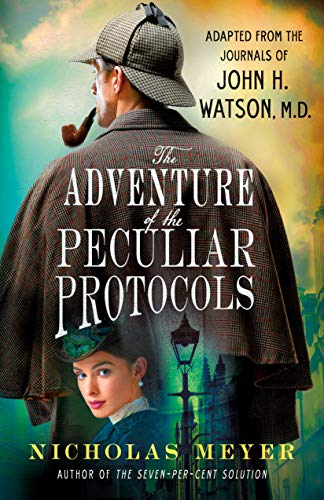
Review of The Adventure of the Peciluair Protocol by Nicholas Meyer

Image of The Adventure of the Peculiar Protocols: Adapted from the Journals of John H. Watson, M.D.

Author : Nicholas Meyer
Release Date: October 15, 2019
Publisher: Minotaur Books
Pages: 256
January 1905: famed detectives Sherlock Holmes and his associate Dr. Watson are summoned by Holmes' brother Mycroft to embark on a secret investigation. An agent of the British Secret Service has been found dead in the River Thames. In the agent’s pocket is a document that appears to be the notes of a meeting of a secret society that’s focused on taking over the world.

Based on real events, the adventure takes the fabled private detective’s and other captivating characters through the heart of Europe aboard the legendary Orient Express. As they travel from Paris into the heart of Russia, Holmes and Watson attempt to trace the origins of the dangerous document. Hot on their heels are men of dubious loyalty, who will stop at nothing to prevent the release of the secret plans. 

The Adventure of the Peculiar Protocols is Nicholas Meyer’s third Sherlock Holmes novel and in this highly entertaining murder mystery we are whimsically transported back in time. Harkening back to the writings of Sir Arthur Conan Doyle and Agatha Christie, Meyer’s capably takes the reader on a gripping journey where Holmes and Watson exposes a secret so massive it shakes the duo to their core. An Academy Award nominated film writer, producer, and director. Meyer’s is also the author of three additional Sherlock Holmes novels that include The Seven-Per-Cent Solution (1974), The West End Horror (1976), and The Canary Trainer (1995).

In this newest adaption we find Sherlock Holmes contemplating his future in the new century. The year is 1905 and there are fewer and fewer mysteries to solve. The aging detective finds himself at a crossroads with technological advances. Just before he and his distinguished partner John H. Watson, M.D. are set to retire, they find renewed propose as they are drawn into another exhilarating murder mystery.

At first the detectives are skeptical of the facts but as they wade deeper and deeper into the case it becomes crystal clear that the stakes are dire. Will Holmes and Watson be able to solve the mystery in time to prevent the secret organization from succeeding in their bid for global supremacy? It is set on the fabled Orient Express, which was made famous in the writing of Agatha Christie. Along the way, Holmes and Watson find themselves intertwined with several eccentric characters. As they contemplate the mystery that is currently unfolding they also ponder the changing world.

“A revolution was taking place half a world away. Events were unfolding that, if the nearsighted chemist enjoying Holmes’s sherry was correct, could conceivably drag the rest of Europe into a conflagration in which massive quantities of British gunpowder might well be required.”

Meyer’s expertise with Sherlock Holmes’ exploits are undeniably evident in this newest adaption. He effortlessly combines his screenwriting and storytelling skills into a fresh take on an old-fashioned murder mystery. While the exchanges between Holmes and Watson feel natural, Holmes’ side narrative of sibling rivalry with his older brother is undeniably entertaining.

“How is your French, Sherlock?” Holmes endeavored to conceal his surprise. “Schoolboy at best, as you are aware,” he confessed. Mycroft, I knew, spoke at least six languages, claiming it took but eight weeks to master a new tongue, which Holmes sneeringly once asserted in my presence was a sure sign of idiocy.” “It will have to do for now,” his brother replied, handing him the envelope.”

Invigoratingly engaging from start to finish, Nicholas Meyer has yet again created a fresh take on an old genre. The Adventure of the Peculiar Protocols is a sure bestseller in which 21st century readers are gloriously transported back to the adventures of Sherlock Holmes and Dr. Watson.  
Review first appeared at the New York Journal of Books on October 16, 2019 - https://www.nyjournalofbooks.com/book-review/adventure-peculiar-protocols

Friday, March 31, 2017

Review of "The Ambulance Drivers" by James McGrath Morris


This review first appeared at the New York Journal of Books on March 27, 2017 http://www.nyjournalofbooks.com/book-review/ambulance-drivers


“Paris represented everything their homeland was not for the generation of Americans writers like Hemingway and Dos Passos who had come of age during the Great War. An incomprehensible number of men, more than 9 million, had been killed, and twice that number had been maimed. It seemed to these young aspiring writers . . .the world was no longer the same and never would be again.”

John Dos Passos and Ernest Hemingway initially crossed paths in 1918 as ambulance drivers in war torn Italy. The two literary icons would met again in the early 1920s in the American expatriate society of Paris where the allure of the city had seduced many writers, artists, and composers. By this time, Dos Passos was already an established author and highly respected, while Hemingway was still an up and comer on the brink of greatness. Throughout the 1920s and better part of the 1930s they were best of friends and honest critics of each other’s works.

“John Dos Passos was one of the few people at certain times whom Ernest could really talk to” and “Their nascent friendship rose out of a unique common bond . . . they dreamed of penning the great books of their generation. They were almost alone among American writers of their age in having witnessed the war that defined their generation.”

Although these two former Chicagoans had many things in common on the surface, they were complete opposites as far as philosophy and temperament. Hemingway was arrogant, certain of himself, willing to get ahead at the expense of others, and athletic. Dos Passos was well educated, timid, considerate to a fault, and not an athlete.

By the mid-1930s, their relationship began to deteriorate. Hemingway became more obsessive about his writing and even more self-centered in his relationships. Dos Passos, who was busy with his own writing was inattentive to Hemingway. The latter’s egoistical selfishness to friends was worsened by his almost total lack of social awareness, his preoccupation with the horrors of war, and his own self-destructive psychoses.

Tiny incidents accumulated to an intolerable level, at least in Hemingway’s mind, and he began to lash out at his baffled friend. The ultimate breaking point, however, came in 1937, during the Spanish Civil War. Hemingway and Dos Passos were in Spain, when José Robles a patriot in the leftist Popular Front and good friend of Dos Passos disappeared under mysterious circumstances. The Hemingway-Dos Passos relationship finally reached its endgame on April 22, 1937, when Hemingway, brimming with confidence and cruelty, told Dos Passos that Robles had been shot as a proven fascist collaborator, a renegade, a dirty spy, a betrayer of his friends. Dos Passos was left shocked and devastated. Their friendship never recovered.

James McGrath Morris, the author of several critically acclaimed biographies, including the New York Times bestselling Eye on the Struggle and Pulitzer delves head first into the mercurial relationship of these two American literary legends in his new book, The Ambulance Drivers: Hemingway, Dos Passos, and a Friendship Made and Lost in War.

Throughout this riveting biography Morris expertly narrates the journeys, relationships, and life-changing events that inspired two of the greatest authors of the 20th century. While Hemingway believed that literature should be a perfect representation of an imperfect world, Dos Passos wanted his writing to change the world. Both versions played a significant role in shaping what would become the voice of the Lost Generation.

The Ambulance Drivers is a lively and engaging biography that takes a fresh look at the life of Dos Passos, but fails to shed any new light into Hemingway, whose life has already been well documented. Although readers may at first hesitate to embark on yet another analysis of Ernest Hemingway, Morris’ framing of the context of his fragile and contemptuous relationship with fellow literary giant John Dos Passos creates a worthwhile read. It will most certainly fascinate Dos Passos and Hemingway aficionados, as well as the casual literary biography enthusiast.

Michael Thomas Barry is the author of seven nonfiction books that includes America’s Literary Legends: The Lives & Burial Places of 50 Great Writers.


Tuesday, February 7, 2017

Review of Blue on Blue by Charles Campisi


Review first appeared at the New York Journal of Books on February 6, 2017 http://www.nyjournalofbooks.com/book-review/blue-on-blue


It’s often said that the police are the “thin blue line,” the fragile wall standing between the public and unrestrained anarchy and crime. But within the realm of policing there is no more despised or guarded assignment then Internal Affairs.

“Their work is often misunderstood, by the public and by others cops. It is racked with uncertainties and ambiguities, not simple black and white but varying shades of grey.”

The domain of Internal Affairs is filled with lies and betrayal, a world of squealers and snitches, wires and wiretaps, shadowy surveillance and covert operations. By necessity officers of Internal Affairs have to operate in the shadows, in secret, separated from their fellow officers. Good cops who recognize that the work they do is essential, are happy they don’t have to do the job themselves. But without these brave, honest, and faithful officers, the thin blue line would most certainly collapse from within.

In Blue on Blue: An Insider’s Story of Good Cops Catching Bad Cops, author Charles Campisi, a recently retired chief of the Internal Affairs Bureau for the NYPD recounts his 40-year career of flushing out crooked cops and combating police corruption. With assistance from veteran reporter and journalist Gordon Dillow, Campisi offers a fascinating and illuminating description of his career within the NYPD from a lowly rank and file officer in some of New York City’s most crime ridden precincts to his reluctant acceptance of head of the Internal Affairs Bureau (IAB).

Campisi is honest but cautious about his assessment of his new job post: “as I leave Ray Kelly’s office . . . All I know is that our mission now is to transform Internal Affairs and I know that’s not going to be easy. Because anybody who thinks he’s going to change the way the NYPD handles corruption and misconduct within its ranks has a lot of history to overcome first.”

With aggressive support from superiors, Campisi sought ways to alter the IAB’s bad reputation.
“As far as most cops are concerned, other cops go into IAB for only three reasons: one, they’re cowards or shirkers who are too afraid or lazy to work on the streets; two, they’re rats who jammed up by their own corruption or misconduct and agreed to work for IAB and rat out other cops to save their own skins; or three, they’re zealots who simply get a sick and twisted pleasure out of persecuting cops.”

During Campisi’s 18-year tenure (1996 to 2014) at the IAB the number of people shot, wounded, or killed by cops declined by almost 90 percent, and the number of cops failing integrity tests shrank to an equally startling low. But to achieve these results wasn’t easy, and Campisi had to triple IAB’s staff, hire the very best detectives, and put the word out that bad apples wouldn’t be tolerated. Although he concedes that eliminating all significant police misconduct is virtually impossible, he emphasizes that the majority of cops do their work professionally and honorably.

Campisi’s narrative is thought provoking, and as an ultimate insider he offers the reading public a rare glimpse inside one of the most secretive branches of policing. Within its pages, he recounts the most critical cases that put the IAB to the test and which ultimately helped clean up the department.
Charles Campisi’s Blue on Blue is a compelling behind the scenes account of what it takes to investigate police officers who cross the line between guardians of the public to criminals. It’s a mesmerizing exposé on the harsh realities and complexities of being a cop on the mean streets of New York City and the challenges of enforcing the law while at the same time obeying it. The breadth and depth of experience of the author and his unwavering commitment to justice makes this a refreshing read that will most certainly enthrall true crime enthusiasts and those interested in the history of modern law enforcement and particularly how police misconduct is handled.

Tuesday, August 2, 2016

American Heiress By Jeffrey Toobin


Rating:
Author: Jeffrey Toobn
Release: August 1, 2016
Publisher Doubleday
Pages: 368
Genre: Nonfiction, History, True Crime, Legal History

Buy from Amazon:

On February 4, 1974, 19-year-old Patricia Campbell Hearst, a junior, majoring in art history at Cal Berkeley and heiress to the Hearst family fortune, was kidnapped by a motley group of self-proclaimed revolutionaries known as the Symbionese Liberation Army.
The sensational and shocking story that unfolded over the next year and half would take many peculiar turns. The immense media attention surrounding the case transfixed the nation and was an integral piece of the puzzle that helped define the 1970s, a decade of perverse violence, political failures, and extreme pessimism. Jeffrey Toobin, bestselling author of Run of His Life: The People v. O.J. Simpson, CNN senior legal analyst and a staff writer at The New Yorker tackles this fascinating and complex story in American Heiress: The Wild Saga of the Kidnapping, Crimes and Trial of Patty Hearst.

Riveting and definitive American Heiress is the story of one the most notorious crime cases of the 20th century. In an easy and captivating style Toobin describes the peculiarities, madness, psychology, and legal maneuverings of the events that surrounded the kidnapping, crimes, and trial of Patty Hearst and others.

The reader is taken on a wild ride that vividly captures the atmosphere and craziness of the SLA radicals and their lethal mix of politics, violence, and sex that shrouded Hearst throughout her entire ordeal. Although she did not cooperate with the book, generally, it is a fairly sympathetic chronicle of her plight. Her fear, tenacity, and ideological conversion are dramatically conveyed within its pages.
“Disoriented, frightened, cold, and alone, Patricia, had no idea where they were going or why. Still, it was in her nature to resist. A more timid teenager might have remained frozen in terror, but Patricia, while still in the dark of the trunk, shucked off her restraints and blindfold. As Bill Harris learned when she howled for help and nearly escaped in her driveway, this woman was a fighter.”

From Randolph and Catherine Hearst’s make shift news conferences to their ill-advised attempt to secure their daughter’s freedom by feeding all the people of Oakland and San Francisco for free; to the astonishing photographs capturing Patty or “Tania” brandishing a machine gun during a bank robbery and her stress-filled year on the lam; to the largest police shoot-out in American history and the first news event to be broadcast live on television; and Patty’s ultimate capture and circuslike trial in which the phrase "Stockholm syndrome" entered the modern vocabulary.

Toobin’s dramatic and engaging style of writing brings to life the many characters and truly bizarre and astonishing events. His meticulous examination and analysis of the evidence is based on hundreds of interviews and thousands of previously unpublished documents.

As Toobin powerfully writes, “The legacy of the SLA itself may be nonexistent, but its story provided a kind of trailer for the modern world. The kidnapping of Patricia Hearst foretold much that would happen to American society in a diverse number of fields.”

Few people in American history have been subjected to as dramatic a transformation of circumstances as Patricia Hearst. In an instant, her life of privilege was gone, replaced by a nightmare of unadulterated horror. And then, most oddly, she reacted to this trauma with ferocious tenacity by becoming a full-fledged member of the very group that had kidnapped her rejecting the very principals with which she was raised.

“Patricia, in the grip of a cold fury, wanted revenge, even more than her remaining captors turned colleagues. She lived off cigarettes and snacks. Days and nights of hiding in grimy motels and squalid apartments gave her a sickly pallor, but adversity for the woman called Tania, made her stronger. In this, there was, despite everything, a hint of her former life.”

Was Hearst a willing participant in the SLA or did she pretend for over a year to keep herself alive? Did her family's money and political connections help her avoid a lengthy jail sentence despite armed robbery, bombings, attempted murder, and felony murder? These questions that have doggedly shadowed the case were unfortunately left mainly unanswered which was somewhat disappointing.
Overall, Jeffrey Toobin’s American Heiress is an informative, compelling, and insightful summer read. A thrill ride that will mesmerize anyone who is fascinated with the social and political complexities of the 1970s, legal history, American crime, or anything related to Patty Hearst.

Michael Thomas Barry is a reviewer for the New York Journal of Books. He is also the author of seven nonfiction books that includes In the Company of Evil: Thirty Years of California Crime, 1950–1980. He is also a columnist for CrimeMagazine.com.


The Hemingway Thief by Shaun Harris


Rating:


Author: Shaun Harris
Release: July 18, 2016
Publisher: Seventh Street Books
Pages: 240
Genre: Fiction, Historical Thriller, Humor

Buy from Amazon: https://www.amazon.com/Hemingway-Thief-Shaun-Harris/dp/163388175X

In early December 1922, Ernest Hemingway was in Switzerland on assignment as a correspondent for the Toronto Daily Star, covering the Lausanne Peace Conference. The journalist and editor Lincoln Steffens was also there. Apparently, Steffens was impressed with Hemingway’s writing and asked to see more.

Hemingway cabled his wife, Hadley in Paris and asked her to bring all of his writings to Switzerland. She quickly packed all of his fiction and poetry, including carbon copies that she could find and hurried off to Gare de Lyon train station. At the station, she got a porter to carry her luggage to the train compartment. During the very brief period when the bags were out of sight, the valise with the manuscripts was stolen.

So what did the thief do with the valise once he realized it only contained the scribblings of an unknown writer? Did he throw it into the Seine? Burn them? Hide them away in an attic? Or is there a more provocative and unforeseen twist? Of course, this is one of literatures great mysteries, these lost manuscripts of one of America’s greatest authors that today would be worth more than their weight in gold. But what if they did survive? Shaun Harris tackles this literary “what if” in his debut novel The Hemingway Thief.

Henry “Coop” Cooper is a successful but discontented romance novelist who is questioning the trajectory of his career. He yearns to become a serious writer and is in need of a jumpstart that will propel his literary credibility.

To clear his mind he’s taken refuge at a low budget beach resort in Baja, Mexico, where he befriends the motel’s eccentric owner, Grady Doyle. The duo soon become entangled in a deadly escapade involving the theft of Ernest Hemingway’s original manuscript to A Moveable Feast, a rare piece of literary history that reveals provocative and unpublished clues to the possible location of a suitcase which contains a treasure trove of the author’s early unpublished works that were stolen in 1922.
In this suspense filled and surprisingly humorous novel of cat and mouse, Coop and company trek across the cartel-laden Sierra Madre in a ramshackle RV in search of Hemingway’s fabled suitcase, finding themselves out of their element at every turn. For Coop this experience could become the storyline of a book of a lifetime . . . that is if he can live long enough to write it.

On a whole the plot construction of this south-of-the-border historical themed thriller was a little silly and occasionally confusing, although it most certainly was not predictable, which is always a pleasant surprise with a debut novel.

The story is filled with stereotypical crime thriller type characters, which is not a bad thing. The overall tone of sarcasm of the good guy protagonists Coop, Grady, and their cohorts (who are always ready with a witty wisecrack), reveal them to be more smart alecky than tough guys was a little bit over the top. Many readers will find the bloodthirstiness of antagonist, Newton Thandy, a conman, gunrunner, and rare book collector to be particularly unique and entertaining given that these “vocations” normally don’t coexist.

On a whole the narrative moves swiftly along and is filled with numerous comical and poignant pop culture references. The premise of the book is quite exceptional, a blend of literary history and suspense, mixed with a pinch of comedy, buddy adventure, and crime thriller. Overall, The Hemingway Thief is a quick and worthwhile read for anyone interested in an amusing crime thriller or anything relating to Ernest Hemingway.

Michael Thomas Barry is a reviewer for the New York Journal of Books and is the author of seven nonfiction books. His most recent book is In the Company of Evil: Thirty Years of California Crime, 1950–1980. Michael is also a columnist for CrimeMagazine.com.


The original review appeared at the New York Journal of Books website on July 18, 2016 and can be found at the following link: http://www.nyjournalofbooks.com/book-review/hemingway-thief