Showing posts with label Making a Murderer. Show all posts

Tuesday, April 4, 2017

Review of "Convicting Avery" by Michael D, Cicchini


The review first appeared at the New York Journal of Books on April 3, 2017 - http://www.nyjournalofbooks.com/book-review/convicting-avery-bizarre-laws-and-broken-system-behind-making-murderer

Buy the book from Amazon through the following link - https://www.amazon.com/Convicting-Avery-Bizarre-Broken-Murderer/dp/1633882551/ref=sr_1_1?ie=UTF8&qid=1491347433&sr=8-1&keywords=convicting+avery

In 2015 Netflix released the controversial documentary Making a Murderer, which explored the story of Steven Avery, a man from Manitowoc County, Wisconsin, who spent nearly two decades in jail for the rape of Penny Beerntsen, before being cleared by DNA evidence in 2003. After his release he sued the Manitowoc County sheriff’s department for wrongful conviction but was arrested in 2005 on charges of murdering Teresa Halbach, a local photographer.

“For every piece of evidence that initially pointed to guilt. Avery’s defense team presented conflicting evidence and also exposed law enforcement’s motives, inconsistent stories, and, at the very minimum, incredibly shoddy investigative work.”

In 2007, Steven Avery was convicted and sentenced to life in prison without the possibility of parole. In Convicting Avery: The Bizarre Laws and Broken System Behind “Making a Murderer,” author Michael D. Cicchini dissects the tangled legal procedures and sketchy evidence that was used to convict Steven Avery and Brendan Dassey. The author himself is a criminal defense attorney in Wisconsin, blogger, and author of several legal books that includes Tried and Convicted: How Police, Prosecutors, and Judges Destroy Our Constitutional Rights (2012). He is also a contributing columnist for the Wisconsin Law Journal.

At the beginning of Chapter two Cicchini writes, “When I first opened my criminal defense practice . . . I started with a naïve belief that trial judges would be wary of wrongfully convicting an innocent defendant . . . but after a few months of practicing law, I completely abandoned my unfounded beliefs and stood corrected.”

By scrutinizing key evidence in the Avery case such as tainted physical evidence, dubious witness testimony, and illegal police searches, Cicchini skillfully examines and explains the legal how’s and why’s of these controversial convictions. He successfully uses the Avery case to highlight police misconduct and the obviously broken Wisconsin legal system while convincingly demonstrating that the injustices perpetrated against Avery and others were not an unusual occurrence. Cicchini writes, “Wisconsin loves its massive, draconian, ever-expanding, and increasingly irrational criminal justice industrial complex.”

Convicting Avery will most definitely captivate fans of the documentary, and while Cicchini had no direct involvement in the Avery case, this book adds expert legal depth to the key procedural and evidentiary issues that were raised in the original documentary. It provides a rare glimpse inside the complex American criminal justice system.

Although this book certainly assumes that the reader is acquainted with the Making a Murderer documentary, the author’s writing style and concise analysis allows those not familiar with legal terminology to easily comprehend the complexities of the case.

Overall, Convicting Avery is a revealing and fascinating read that will interest readers of true crime, criminal law, or American legal procedures. It will most certainly stimulate further discussions of how someone can be railroaded and falsely convicted of a crime. But regardless of your position on Steven Avery's guilt or innocence, the content of this book raises important concerns about a clearly broken legal system.

Tuesday, February 28, 2017

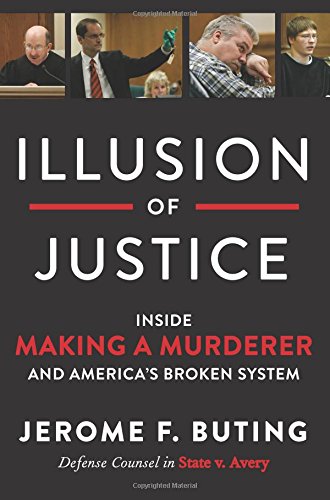
Review of Illusions of Justice by Jerome F. Buting

Image of Illusion of Justice: Inside Making a Murderer and America's Broken System

Book review first appeared at the New York Journal of Books on February 28, 2017 http://www.nyjournalofbooks.com/book-review/illusion

Buy the book through Amazon - https://www.amazon.com/Illusion-Justice-Inside-Murderer-Americas/dp/0062569317/ref=sr_1_1?ie=UTF8&qid=1488301738&sr=8-1&keywords=illusions+of+justice

“Yes, I believe [Steven] Avery is innocent. This is my opinion, which I know is not worth very much, but my opinion is based on an assessment of the evidence.”
—Jerome F. Buting

In 1985, Steven Avery was convicted of sexual assault and attempted murder and served 18 years in prison before being exonerated by DNA evidence. After his release, he filed a multimillion dollar civil lawsuit against Manitowoc County, Wisconsin. In November 2005, while this suit was pending, he was charged and later convicted of the murder of Teresa Halbach and sentenced to life imprisonment without possibility of parole.

The handling of the Halbach murder case was highly controversial and his defense lawyers, Jerome Buting and Dean Strang, argued that their client had been set up by his judicial rivals. Avery’s 2007 murder trial and its related issues were the focus of the wildly popular and provocative Netflix original documentary series, Making a Murderer, which was released in December 2015.

In Illusions of Justice: Inside making a Murderer and America’s Broken System, Jerome F. Buting links his version of the Avery murder trial with other cases from his 35-year career as a criminal defense attorney. From his early career as a public defender to his success overturning wrongful convictions working with the Innocence Project, Buting’s first foray into memoir delivers an insightful look at the rampant bias and shocking realities of criminal defense law.

“. . . with greater regularity than people outside the system might expect, the American criminal justice system leads to results that are unreliable, unjust, and sometimes both.”

Buting states that his purpose in writing this book was not to “retry the Avery case day by day” but to highlight what he saw as the central issues in the case. He states that his perspectives were shaped not only by the facts of the case but also by his previous experiences as a criminal defense attorney.
In this easy to read narrative, Buting explores his personal life, which includes a deeply personal and emotional account of his battle with cancer, while explaining and outlining his career-defining cases. He also sheds light on the imperfections of America’s justice system and provides a thought provoking and credible outline for its improvement.

“I have always looked at the career of a criminal defense lawyer as more of a vocation than a job. But cancer was a wake-up call. It helped me understand how people must feel when they find themselves wrongly accused as a defendant in court, totally dependent on an expert . . . to guide them through the labyrinthine criminal justice system.”

He goes on to write, “The saga of Steven Avery, which unfolded in a sweeping narrative studded with intricate detail, stunned many as a portrayal of a badly warped American justice system.” When he agreed to team-up with fellow defense attorney Dean Strang in the Avery case, he instinctively knew that they were involved in a tragic case that bordered on Shakespearean proportions.

“This was the kind of profound challenge that a good attorney in the prime of his career should not shy away from. The Avery case would test our faith in this system like few others. It had all the elements of the awesome power of the government juggernaut arrayed against one man, who had been an outcast his whole life.”

Buting’s Illusion of Justice is thought provoking and delivers critical interpretations and powerful commentary on the problems that are plaguing our criminal justice system. Through painstaking analysis and evidence, the author provides an unyielding and persuasive argument both for Steven Avery’s innocence and the need for change within our criminal justice system. His unwavering advocacy for justice in the face of overwhelming obstacles is commendable and must be applauded. This book is a must read for legal scholars, true crime enthusiasts, or anyone interested in the complexities of America’s criminal justice system.