Showing posts with label true crime book reviews. Show all posts

Monday, March 6, 2017

Review of Murder in Plain English by Michael Arntfield & Marchel Danesi

Murder in Plain English: From Manifestos to Memes--Looking at Murder through the Words of Killers

The review first appeared at the New York Journal of Books on March 6, 2017 http://www.nyjournalofbooks.com/book-review/murder-plain-english

Buy the book through Amazon - https://www.amazon.com/Murder-Plain-English-Manifestos-Memes-Looking/dp/1633882535/ref=sr_1_1?ie=UTF8&qid=1488840796&sr=8-1&keywords=murder+in+plain+english

“Humans are the planet’s outliers when it comes to murder. We are, needless to say, also the only species that has the ability to document our experiences associated with murder through the written word.”

Why are we as a society so obsessed with crime? Our fascination with murder in particular has led to the writing of countless volumes of books which have further stoked the insatiable need to know as much as possible about these heinous acts as possible. Is there a link between murder and literature? And how can we use the writings of killers to identify them, catch them, and stop them? Murder in Plain English: From Manifestos to Memes—Looking at Murder through the Words of Killers, co-authored by Michael Arntfield, a professor of criminology at Western University and Marcel Danesi, a professor of anthropology at the University of Toronto, attempt to answer this unique and thought provoking question.

“The first book to examine murder through the written word, not only the writings of the killers themselves, but also the story of murder as told in literary fiction and crime dramas that are now a staple of film and television. Based on extensive research and interviews with convicted murderers, the book emphasizes the often-overlooked narrative impulse that drives killers, explaining how both mass and serial murderers perceive their crimes as stories and why a select few are compelled to commit these stories to writing whether before, during or after their horrific acts.”

Arntfield and Danesi call their tantalizing theory, “literary criminology,” the study of crime through literature and language. In this book they attempt to “penetrate the raison d'ĂȘtre of murder, through two sets of eyes, those of the literary writer and those of the murderer-as-writer.”

Early on in the text the authors make an astounding statement that they believe “countless deranged killers . . . were failed writers of one kind or another,” and further state, “literary genius . . . is rather common. Mass murderers, terrorists, and serial killers alike, regardless of education or literary level, demonstrate a consistent narrative impulse to both document and rationalize their grisly crimes.” Although part of this statement is true, they never fully backed up the murderer as “literary genius” claim with any evidence.

Murder in Plain English includes an extraordinary large and impressive collection of murderers and their foul deeds, both well-known and obscure. Be warned this is not a book for the faint of heart and is explicit in its descriptions. Unfortunately, the sheer number of stories, its rambling disjointed nature, and academic writing style makes for a difficult and often unpleasant read.

While the books premise is extraordinarily unique, the author’s obvious bias and often forced inferences on the evidence, instead of reasoning from facts to conclusions leave the reader confused. Despite all the specifics, analysis, and provocative nature of the subject matter there is no greater understanding of the reasons why people commit murder. The mere statements of killers and madmen, whether in written confessions, letters, diary entries, manifestos, or memes cannot be considered literature and any attempt at connecting the two is a stretch beyond the point of reason. In the words of the authors themselves “This linkage between writing and murder has undergone very little expert scrutiny or analysis,” and to be honest there’s a reason for that.

Tuesday, February 28, 2017

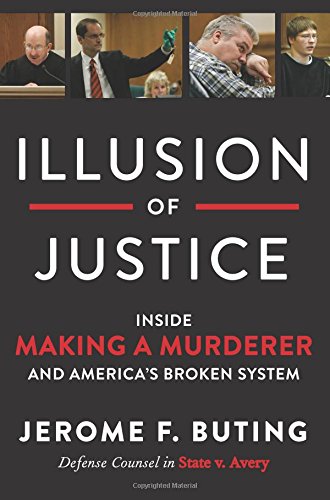
Review of Illusions of Justice by Jerome F. Buting

Image of Illusion of Justice: Inside Making a Murderer and America's Broken System

Book review first appeared at the New York Journal of Books on February 28, 2017 http://www.nyjournalofbooks.com/book-review/illusion

Buy the book through Amazon - https://www.amazon.com/Illusion-Justice-Inside-Murderer-Americas/dp/0062569317/ref=sr_1_1?ie=UTF8&qid=1488301738&sr=8-1&keywords=illusions+of+justice

“Yes, I believe [Steven] Avery is innocent. This is my opinion, which I know is not worth very much, but my opinion is based on an assessment of the evidence.”
—Jerome F. Buting

In 1985, Steven Avery was convicted of sexual assault and attempted murder and served 18 years in prison before being exonerated by DNA evidence. After his release, he filed a multimillion dollar civil lawsuit against Manitowoc County, Wisconsin. In November 2005, while this suit was pending, he was charged and later convicted of the murder of Teresa Halbach and sentenced to life imprisonment without possibility of parole.

The handling of the Halbach murder case was highly controversial and his defense lawyers, Jerome Buting and Dean Strang, argued that their client had been set up by his judicial rivals. Avery’s 2007 murder trial and its related issues were the focus of the wildly popular and provocative Netflix original documentary series, Making a Murderer, which was released in December 2015.

In Illusions of Justice: Inside making a Murderer and America’s Broken System, Jerome F. Buting links his version of the Avery murder trial with other cases from his 35-year career as a criminal defense attorney. From his early career as a public defender to his success overturning wrongful convictions working with the Innocence Project, Buting’s first foray into memoir delivers an insightful look at the rampant bias and shocking realities of criminal defense law.

“. . . with greater regularity than people outside the system might expect, the American criminal justice system leads to results that are unreliable, unjust, and sometimes both.”

Buting states that his purpose in writing this book was not to “retry the Avery case day by day” but to highlight what he saw as the central issues in the case. He states that his perspectives were shaped not only by the facts of the case but also by his previous experiences as a criminal defense attorney.
In this easy to read narrative, Buting explores his personal life, which includes a deeply personal and emotional account of his battle with cancer, while explaining and outlining his career-defining cases. He also sheds light on the imperfections of America’s justice system and provides a thought provoking and credible outline for its improvement.

“I have always looked at the career of a criminal defense lawyer as more of a vocation than a job. But cancer was a wake-up call. It helped me understand how people must feel when they find themselves wrongly accused as a defendant in court, totally dependent on an expert . . . to guide them through the labyrinthine criminal justice system.”

He goes on to write, “The saga of Steven Avery, which unfolded in a sweeping narrative studded with intricate detail, stunned many as a portrayal of a badly warped American justice system.” When he agreed to team-up with fellow defense attorney Dean Strang in the Avery case, he instinctively knew that they were involved in a tragic case that bordered on Shakespearean proportions.

“This was the kind of profound challenge that a good attorney in the prime of his career should not shy away from. The Avery case would test our faith in this system like few others. It had all the elements of the awesome power of the government juggernaut arrayed against one man, who had been an outcast his whole life.”

Buting’s Illusion of Justice is thought provoking and delivers critical interpretations and powerful commentary on the problems that are plaguing our criminal justice system. Through painstaking analysis and evidence, the author provides an unyielding and persuasive argument both for Steven Avery’s innocence and the need for change within our criminal justice system. His unwavering advocacy for justice in the face of overwhelming obstacles is commendable and must be applauded. This book is a must read for legal scholars, true crime enthusiasts, or anyone interested in the complexities of America’s criminal justice system.