Showing posts with label Michael Arntfield. Show all posts

Saturday, September 8, 2018

Review of Monster City by Michael Arntfield

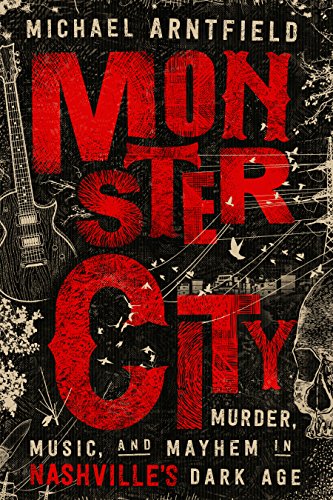
Image of Monster City: Murder, Music, and Mayhem in Nashville’s Dark Age
Author: Michael Arntfield
Release date: September 4, 2018
Publisher: Little A
Pages: 300
“When I hear music, I fear no danger. I am invulnerable. I see no foe.” —Henry Davis Thoreau, “Winter”
Nashville is a hub for hopeful musicians and a magnet for country music fans. It’s often referred to as Music City, and by the time Pat Postiglione arrived there in 1980, it had already borne witness to a string of brutal unsolved sex slayings. These murders would serve as a portent to worse things to come. As Postiglione was promoted from Metro beat cop to detective sergeant in the elite cold-case unit “Murder Squad,” some of America’s most heinous, elusive, and violent serial killers were calling Nashville home. Over the next two decades, the body count continued to climb.
From Vanderbilt University to dive bars and out-of-the-way motels, Postiglione followed the blood-stained tracks of these ever-escalating crimes—each perpetrated by a different killer who had one thing in common: the intent to murder without motive or remorse. But of all the investigations, of all the fiends Postiglione hunted, few were as frightening, or as game changing, as the Rest Stop Killer: a homicidal trucker who turned the interstates into his trolling ground. His next stop was Nashville, but Postiglione was waiting.
“. . . he hadn’t returned to Music City for the pedal steels, fiddles, or line dancing . . . He was awake now. His eyes wide open. When it was all over, they would use newfangled terms like activated psychopath and malignant narcissist to try to capture the essence of his malevolence—to clinically classify and quantify his pure evil . . . He’d inevitably fooled just about everyone . . . But there was one person he couldn’t fool. It was the one cop who’s caught him—the same cop who’d solved his first murder and who’d lock him up . . .”
Michael Arntfield is a true crime broadcaster, university professor, former police detective, and author of over a dozen books and articles that include the bestselling Murder City: The Untold Story of Canada's Serial Killer Capital, 1959–1984 (2015, Friesen Press). In his captivating new book, Monster City: Murder, Music and Mayhem in Nashville’s Dark Age, Arntfield examines the true accounts of the serial killers who terrorized Nashville during the last decades of the 20th century and the elite police squad that was determined to bring them to justice. In it he contends that the characteristics of the serial killings committed during this time frame were perpetrated by “the hedonistic-thrill killer . . . a special breed of psychopath with an insatiable desire for stimulation.”
Throughout Monster City Arntfield does an excellent job of detailing the investigations, forensics, and theories behind the motivations of these brutal murders. It is a powerful expose that studies the deep dark nature of the criminal mind.
Although at times Arntfield’s writing style tends to be a little bit sensational and there’s some repetition, overall this book is informative and shines a spotlight on some of Nashville’s most brutal and long forgotten crimes. It also does an excellent job of describing the heroic police detectives who put themselves in harm’s way. These brave men and women through countless hours of self-sacrifice to pursue these heinous criminals to make our streets safe for everyone. Their steadfast resolve and persistence must be honored and applauded. Monster City will make an excellent addition to any true crime enthusiast's library.
Michael Thomas Barry is the author of eight nonfiction books and a staff reviewer for the New York Journal of Books.

This review first appeared at the New York Journal of Books on September 7, 2018 - https://www.nyjournalofbooks.com/book-review/monster-city

Monday, March 6, 2017

Review of Murder in Plain English by Michael Arntfield & Marchel Danesi

Murder in Plain English: From Manifestos to Memes--Looking at Murder through the Words of Killers

The review first appeared at the New York Journal of Books on March 6, 2017 http://www.nyjournalofbooks.com/book-review/murder-plain-english

Buy the book through Amazon - https://www.amazon.com/Murder-Plain-English-Manifestos-Memes-Looking/dp/1633882535/ref=sr_1_1?ie=UTF8&qid=1488840796&sr=8-1&keywords=murder+in+plain+english

“Humans are the planet’s outliers when it comes to murder. We are, needless to say, also the only species that has the ability to document our experiences associated with murder through the written word.”

Why are we as a society so obsessed with crime? Our fascination with murder in particular has led to the writing of countless volumes of books which have further stoked the insatiable need to know as much as possible about these heinous acts as possible. Is there a link between murder and literature? And how can we use the writings of killers to identify them, catch them, and stop them? Murder in Plain English: From Manifestos to Memes—Looking at Murder through the Words of Killers, co-authored by Michael Arntfield, a professor of criminology at Western University and Marcel Danesi, a professor of anthropology at the University of Toronto, attempt to answer this unique and thought provoking question.

“The first book to examine murder through the written word, not only the writings of the killers themselves, but also the story of murder as told in literary fiction and crime dramas that are now a staple of film and television. Based on extensive research and interviews with convicted murderers, the book emphasizes the often-overlooked narrative impulse that drives killers, explaining how both mass and serial murderers perceive their crimes as stories and why a select few are compelled to commit these stories to writing whether before, during or after their horrific acts.”

Arntfield and Danesi call their tantalizing theory, “literary criminology,” the study of crime through literature and language. In this book they attempt to “penetrate the raison d'ĂȘtre of murder, through two sets of eyes, those of the literary writer and those of the murderer-as-writer.”

Early on in the text the authors make an astounding statement that they believe “countless deranged killers . . . were failed writers of one kind or another,” and further state, “literary genius . . . is rather common. Mass murderers, terrorists, and serial killers alike, regardless of education or literary level, demonstrate a consistent narrative impulse to both document and rationalize their grisly crimes.” Although part of this statement is true, they never fully backed up the murderer as “literary genius” claim with any evidence.

Murder in Plain English includes an extraordinary large and impressive collection of murderers and their foul deeds, both well-known and obscure. Be warned this is not a book for the faint of heart and is explicit in its descriptions. Unfortunately, the sheer number of stories, its rambling disjointed nature, and academic writing style makes for a difficult and often unpleasant read.

While the books premise is extraordinarily unique, the author’s obvious bias and often forced inferences on the evidence, instead of reasoning from facts to conclusions leave the reader confused. Despite all the specifics, analysis, and provocative nature of the subject matter there is no greater understanding of the reasons why people commit murder. The mere statements of killers and madmen, whether in written confessions, letters, diary entries, manifestos, or memes cannot be considered literature and any attempt at connecting the two is a stretch beyond the point of reason. In the words of the authors themselves “This linkage between writing and murder has undergone very little expert scrutiny or analysis,” and to be honest there’s a reason for that.