Tuesday, February 28, 2017

Review of Illusions of Justice by Jerome F. Buting

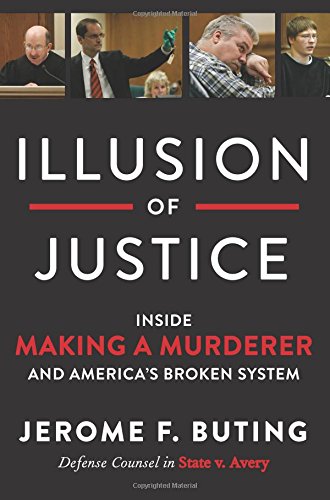
Image of Illusion of Justice: Inside Making a Murderer and America's Broken System

Book review first appeared at the New York Journal of Books on February 28, 2017 http://www.nyjournalofbooks.com/book-review/illusion

Buy the book through Amazon - https://www.amazon.com/Illusion-Justice-Inside-Murderer-Americas/dp/0062569317/ref=sr_1_1?ie=UTF8&qid=1488301738&sr=8-1&keywords=illusions+of+justice

“Yes, I believe [Steven] Avery is innocent. This is my opinion, which I know is not worth very much, but my opinion is based on an assessment of the evidence.”
—Jerome F. Buting

In 1985, Steven Avery was convicted of sexual assault and attempted murder and served 18 years in prison before being exonerated by DNA evidence. After his release, he filed a multimillion dollar civil lawsuit against Manitowoc County, Wisconsin. In November 2005, while this suit was pending, he was charged and later convicted of the murder of Teresa Halbach and sentenced to life imprisonment without possibility of parole.

The handling of the Halbach murder case was highly controversial and his defense lawyers, Jerome Buting and Dean Strang, argued that their client had been set up by his judicial rivals. Avery’s 2007 murder trial and its related issues were the focus of the wildly popular and provocative Netflix original documentary series, Making a Murderer, which was released in December 2015.

In Illusions of Justice: Inside making a Murderer and America’s Broken System, Jerome F. Buting links his version of the Avery murder trial with other cases from his 35-year career as a criminal defense attorney. From his early career as a public defender to his success overturning wrongful convictions working with the Innocence Project, Buting’s first foray into memoir delivers an insightful look at the rampant bias and shocking realities of criminal defense law.

“. . . with greater regularity than people outside the system might expect, the American criminal justice system leads to results that are unreliable, unjust, and sometimes both.”

Buting states that his purpose in writing this book was not to “retry the Avery case day by day” but to highlight what he saw as the central issues in the case. He states that his perspectives were shaped not only by the facts of the case but also by his previous experiences as a criminal defense attorney.
In this easy to read narrative, Buting explores his personal life, which includes a deeply personal and emotional account of his battle with cancer, while explaining and outlining his career-defining cases. He also sheds light on the imperfections of America’s justice system and provides a thought provoking and credible outline for its improvement.

“I have always looked at the career of a criminal defense lawyer as more of a vocation than a job. But cancer was a wake-up call. It helped me understand how people must feel when they find themselves wrongly accused as a defendant in court, totally dependent on an expert . . . to guide them through the labyrinthine criminal justice system.”

He goes on to write, “The saga of Steven Avery, which unfolded in a sweeping narrative studded with intricate detail, stunned many as a portrayal of a badly warped American justice system.” When he agreed to team-up with fellow defense attorney Dean Strang in the Avery case, he instinctively knew that they were involved in a tragic case that bordered on Shakespearean proportions.

“This was the kind of profound challenge that a good attorney in the prime of his career should not shy away from. The Avery case would test our faith in this system like few others. It had all the elements of the awesome power of the government juggernaut arrayed against one man, who had been an outcast his whole life.”

Buting’s Illusion of Justice is thought provoking and delivers critical interpretations and powerful commentary on the problems that are plaguing our criminal justice system. Through painstaking analysis and evidence, the author provides an unyielding and persuasive argument both for Steven Avery’s innocence and the need for change within our criminal justice system. His unwavering advocacy for justice in the face of overwhelming obstacles is commendable and must be applauded. This book is a must read for legal scholars, true crime enthusiasts, or anyone interested in the complexities of America’s criminal justice system.

Tuesday, February 7, 2017

Review of Blue on Blue by Charles Campisi


Review first appeared at the New York Journal of Books on February 6, 2017 http://www.nyjournalofbooks.com/book-review/blue-on-blue


It’s often said that the police are the “thin blue line,” the fragile wall standing between the public and unrestrained anarchy and crime. But within the realm of policing there is no more despised or guarded assignment then Internal Affairs.

“Their work is often misunderstood, by the public and by others cops. It is racked with uncertainties and ambiguities, not simple black and white but varying shades of grey.”

The domain of Internal Affairs is filled with lies and betrayal, a world of squealers and snitches, wires and wiretaps, shadowy surveillance and covert operations. By necessity officers of Internal Affairs have to operate in the shadows, in secret, separated from their fellow officers. Good cops who recognize that the work they do is essential, are happy they don’t have to do the job themselves. But without these brave, honest, and faithful officers, the thin blue line would most certainly collapse from within.

In Blue on Blue: An Insider’s Story of Good Cops Catching Bad Cops, author Charles Campisi, a recently retired chief of the Internal Affairs Bureau for the NYPD recounts his 40-year career of flushing out crooked cops and combating police corruption. With assistance from veteran reporter and journalist Gordon Dillow, Campisi offers a fascinating and illuminating description of his career within the NYPD from a lowly rank and file officer in some of New York City’s most crime ridden precincts to his reluctant acceptance of head of the Internal Affairs Bureau (IAB).

Campisi is honest but cautious about his assessment of his new job post: “as I leave Ray Kelly’s office . . . All I know is that our mission now is to transform Internal Affairs and I know that’s not going to be easy. Because anybody who thinks he’s going to change the way the NYPD handles corruption and misconduct within its ranks has a lot of history to overcome first.”

With aggressive support from superiors, Campisi sought ways to alter the IAB’s bad reputation.
“As far as most cops are concerned, other cops go into IAB for only three reasons: one, they’re cowards or shirkers who are too afraid or lazy to work on the streets; two, they’re rats who jammed up by their own corruption or misconduct and agreed to work for IAB and rat out other cops to save their own skins; or three, they’re zealots who simply get a sick and twisted pleasure out of persecuting cops.”

During Campisi’s 18-year tenure (1996 to 2014) at the IAB the number of people shot, wounded, or killed by cops declined by almost 90 percent, and the number of cops failing integrity tests shrank to an equally startling low. But to achieve these results wasn’t easy, and Campisi had to triple IAB’s staff, hire the very best detectives, and put the word out that bad apples wouldn’t be tolerated. Although he concedes that eliminating all significant police misconduct is virtually impossible, he emphasizes that the majority of cops do their work professionally and honorably.

Campisi’s narrative is thought provoking, and as an ultimate insider he offers the reading public a rare glimpse inside one of the most secretive branches of policing. Within its pages, he recounts the most critical cases that put the IAB to the test and which ultimately helped clean up the department.
Charles Campisi’s Blue on Blue is a compelling behind the scenes account of what it takes to investigate police officers who cross the line between guardians of the public to criminals. It’s a mesmerizing exposé on the harsh realities and complexities of being a cop on the mean streets of New York City and the challenges of enforcing the law while at the same time obeying it. The breadth and depth of experience of the author and his unwavering commitment to justice makes this a refreshing read that will most certainly enthrall true crime enthusiasts and those interested in the history of modern law enforcement and particularly how police misconduct is handled.

Thursday, December 1, 2016

Review of "By Women Possessed: A Life of Eugene O'Neill" By Arthur and Barbara Gelb


Review was first published at the New York Journal of Books on December 1, 2016 http://www.nyjournalofbooks.com/book-review/women-possessed


Nobel Prize winning playwright Eugene O’Neill was a pioneer of the American theater and led the way for other literary legends such as Tennessee Williams, Arthur Miller, and Edward Albee. His true legacy is found in his ability to fearlessly tackle social and political values that today continue to inspire countless generations of authors and productions.

Since his death in 1953, O’Neill’s treasure trove of works such as Long Day’s Journey into Night and others have been in constant production around the world. Although he was a very talented writer, O’Neill was a deeply flawed human being, who struggled his entire life with depression and alcohol abuse, which presented challenges in all of his personal relationships.

“But, whatever O’Neill’s personal failings, there is no denying that, as an artist, he stood tall. An idealist and visionary, he bravely endured his years of struggle, demanding to be accepted on his own terms as a dramatist.”

The celebrated and award winning husband and wife team of Arthur and Barbara Gelb have spent 50+ years studying and examining the life of Eugene O’Neill, and their previous works include O’Neill (1962) and O’Neill: Life with Monte Cristo (2000). Arthur Gelb died on May 20, 2014 and Barbara “wearily polished” the final few pages of their final collaboration, a book they had been grappling with for nearly a decade. Their third and final collaboration in the O’Neill saga, By Women Possessed: A Life of Eugene O’Neill, is an 869 page epic, in which the Gelbs examine the last 25 years of the playwright’s life through his stormy relationships with the most important women in his life, primarily his third wife, actress Carlotta Monterey.

The word comprehensive is often used to define thoroughly researched biographies and other works, but this definition doesn’t even begin to scratch the surface in the amount of excruciating detail the Gelbs have provided in this volume. The majority of the book is spent discussing his emotionally tempestuous marriage to Monterey, which was dominated by years of alcoholic setbacks, mental and physical decline, and hostile resentment. Within this volume are also discussed some of the longstanding misconceptions of O’Neill’s life such as his battle with alcoholism and depression, as well as his views on feminism and racism.

“He also had a violent and destructive temper, especially when he was on a drinking binge. At those times, he didn’t hesitate to manhandle his lovers.”

Unfortunately, there are only brief discussions of O’Neill’s early marriages and his complicated relationship with his mother.

“When, as an adolescent, Eugene O’Neill realized that his mother, Ella Quinlan O’Neill, blamed her morphine addiction on his birth and confessed she wished him unborn, she betrayed him in a way he could never forgive or forget.”

In this work the authors rely primarily of the previously unpublished diaries and interviews of Monterey as well as material from friends and associates. Monterey gave the authors a melancholy version of O’Neill’s final years as a sick and forgotten man who isolated himself from his family and fans.

“O’Neill hated hotels, she told us, because he had been born in one and had spent the first seven years of life traveling from hotel to hotel while his father toured the country with his acting company. . . .” She repeated what are commonly claimed to be O’Neill’s final words, spoken on November 21, 1953, “Born in a hotel room and God damn it, died in a hotel room.”

By Women Possessed is a captivating and in-depth study of one of America’s most revered literary giants. This volume is a superb example of a skillful, thorough, and cynically examined editorial biography that draws from an exhaustive treasure strove of previously unexploited source material. It offers the reader an extraordinary and thought provoking view on the playwright’s life and works. By Women Possessed is heartily recommend to anyone interested in the American theater, Eugene O’Neill, or biography in general.

Thursday, November 17, 2016

Review of Deirdre Bair's "Al Capone: His Life, Legacy, and Legend"


Review first appeared at the New York Journal of Books on November 16, 2016 http://www.nyjournalofbooks.com/book-review/al-capone

Buy the book at Amazon - https://www.amazon.com/Al-Capone-Life-Legacy-Legend/dp/0385537158/ref=sr_1_1?ie=UTF8&qid=1479399607&sr=8-1&keywords=al+capone

“Al Capone was a son, husband, and father who was looking for the best way to become a good provider for everyone.”

Nearly seven decades after his death, what is it about Al Capone that captures the imagination? Some lives contain multitudes, and his would seem to be one of them. From his heyday to the present, his life has enthralled the public’s collective imagination.

Born on January 17, 1899, in Brooklyn, New York, to Italian immigrant parents, Capone would become one of the most notorious crime figures in American history. During the height of Prohibition, his criminal enterprises dominated the city of Chicago and included bootlegging, prostitution, and gambling.

His long-running turf war with rival gangs came to a bloody and shocking crescendo on St. Valentine's Day 1929. Through it all, the charismatic Capone remained barely above it all, and Federal income tax evasion was his eventual undoing. In 1931 he was sentenced to eleven years in federal prison but served a little over half his sentence, mostly at Alcatraz. A very ill Capone, suffering from the physical and mental effects of syphilis, was released to live out his final years in Miami.

Deirdre Bair, National Book Award winner and author of numerous biographies, attempts to uncover a more personal side of the infamous crime boss and examines the legend and facts surrounding this intriguing and enigmatic figure in her new biography, Al Capone: His Life, Legacy, and Legend.

“His ascent in mobdom was phenomenal, his time at the top sensational, and his downfall meteoric. Indeed, his reign did last only six short years, but everything that happened in that brief time still commands worldwide attention, interest, and speculation.”

The book follows Capone’s entire life from his humble beginnings in Brooklyn to his rise as crime boss in Chicago through his astonishingly swift downfall and imprisonment and death in 1947.

“This is the story of a ruthless killer, a scofflaw, a keeper of brothels and bordellos, a tax cheat and perpetrator of frauds, convicted felon, and a mindless, blubbering invalid. This is also the story of a loving son, husband, and father who described himself as a businessman whose job was to serve the people what they wanted.”

Written with the cooperation of Capone’s family and descendants, Al Capone does a wonderful job of gathering all of the urban myths surrounding his life and career and lays them out side by side with the facts, exposing and demystifying their falsehoods from the realities. “Attempting to reconstruct their truth is much like trying to solve the most complicated puzzle imaginable.”

Although this book is superbly documented and researched, its end results are mixed. The narrative is somewhat dry and uninspiring in its presentation and ultimately failed to uncover any startling new information. In the end, this book is best suited for readers who already have a basic understanding and familiarity with the subject matter. It is recommended for anyone interested in anything related to organized crime, Al Capone, and the Prohibition era in general. 

Tuesday, November 8, 2016

Review of Robert Masello's - The Jekyll Revelation


Review first appeared at the New York Journal of Books on November 8, 2016 http://www.nyjournalofbooks.com/book-review/jekyll-revelation

Buy the book - https://www.amazon.com/s/ref=nb_sb_noss_2?url=search-alias%3Daps&field-keywords=robert+masello

What if the terrifying legacy of Jack the Ripper and Robert Louis Stevenson’s Dr. Jekyll and Mr. Hyde were connected and somehow transported across space and time from Victorian England to present day California? The consequences would be terrifying. Robert Masello, an award-winning journalist, television writer, and the bestselling author of numerous supernatural and historical thrillers that includes The Einstein Prophecy tackles this innovative and thought provoking historical whodunit in his new book The Jekyll Revelation.

Protagonist Rafael Salazar, an environmental scientist on routine patrol in Topanga Canyon, California, expects to find animal poachers but instead discovers a mysterious antique steamer trunk filled with a treasure trove of artifacts that includes a puzzling journal, written by none other than legendary author Robert Louis Stevenson. The journal cryptically reveals chilling details regarding the creation of his classic horror novel The Strange Case of Dr. Jekyll and Mr. Hyde and an even more disturbing link to one of the most notorious serial killers of all-time. Within the pages of this mysterious journal is disclosed the true identity of Jack the Ripper.

“I begin this journal in high, if somewhat desperate, hopes. I mean to make it a record of my deliverance. If it becomes something other than that, it shall have served as my epitaph. A bookmark . . . or a bookend.”

The journal, unfortunately, wasn’t the only artifact in the trunk, and isn’t the only memento that has been pilfered. A bottle that purportedly contains the last drops of the potion that inspired Jekyll and Hyde and also created London’s most infamous killer has disappeared and fallen into the wrong hands. With parallel story lines set in present day California and 1880s London, The Jekyll Revelation masterfully alternates between reluctant hero’s Salazar and Stevenson as both attempt to stop the terror that has been unleased within their respective time periods.

Masello has done an admirable job of creating recognizable characters, although they tend to be somewhat formulaic. He sticks with the standard literary storyline of man playing God and its catastrophic fallout. The Jekyll Revelation is a fast-paced tour de force through history and contemporary California. It is a heart-pounding page turner filled with loads of action and intrigue.

“The brilliantly executed crime of Jack the Ripper have been laid at a dozen doorsteps, but none of them mine. Nor will they be, not so long as I am alive to be called to account for them. No, I mean to keep this journal, and my souvenirs, intact and unknown. They shall travel with me wherever I go (at this moment, my native California is again striking my fancy), and when, many years from now, my end draws near, I shall consign them to some appropriate grave. An unmarked spot where, in the fullness of time posterity shall rediscover, and perhaps reassess them. I leave that to fate.”

Masello has crafted an exceptional murder mystery with a literary twist that will not disappoint. This novel will most certainly captivate anyone who loves true crime, suspense thrillers, literary history, Robert Louis Stevenson, or Jack the Ripper. A must read and highly recommended.

Wednesday, October 19, 2016

Review of James Patterson's - Filthy Rich


Original review appeared at the New York Journal of Books on (October 19, 2016)
http://www.nyjournalofbooks.com/book-review/filthy-rich-powerful

Buy the book from Amazon - https://www.amazon.com/Filthy-Rich-Powerful-Billionaire-Shocking/dp/0316274054/ref=sr_1_1?ie=UTF8&qid=1476916468&sr=8-1&keywords=filthy+rich

In February 2005, 14-year-old Mary (not her real name) was a naïve and impressionable teenager. She desperately sought out attention and wanted to make a good first impression. The money she would earn in one hour for giving an old man a massage was more than her father made in a whole day.

“What she tells herself, over and over again, is: It’s not that big a deal.”

But of course, it is a big deal and her visit to the mansion of eccentric billionaire Jeffrey Epstein would result in one of the most scandalous criminal investigations in Palm Beach history. In Filthy Rich: A Powerful Billionaire, the Sex Scandal that Undid Him, and All the Justice that Money Can Buy: The Shocking True Story of Jeffrey Epstein, James Patterson, one of the world’s most successful thriller authors in collaboration with John Connelly and Tim Mallory, tackle this deeply troubling and captivating case.

So who is Jeffrey Epstein, really?

Epstein was a highly successful financier, investor, and philanthropist who contributed millions of dollars to academic institutions around the globe. He funded numerous political campaigns and hob knobbed with a wide-ranging and diverse cast of characters that included Prince Andrew, Bill Clinton, Donald Trump, and many others. He rose from humble origins to the heights of New York City and Palm Beach’s privileged and societal elites.

On the surface he appeared to have it all: fame, fortune, and achievement but behind closed doors he wanted more and for many years successfully concealed a perverse sexual appetite for pretty underage girls. This compulsion would eventually led to his downfall with allegations of abuse by dozens of young women whom he employed as “masseuses” at his opulent Palm Beach estate and other properties.

Backed by a plethora of high powered defense attorneys that included Gerald Lefcourt, Alan Dershowitz, and later, Ken Starr, this dream team masterfully orchestrated a plea bargain for Epstein who avoided serious charges in exchange for a guilty plea to felony solicitation of prostitution and the procurement of minors for prostitution.

He received a sentence of 18 months and was required to register as a class three sex offender. One other concession was the media would not be alerted to his ultimate release date, which occurred on July 21, 2009. This was a mere slap on the wrist for the atrocious crimes that were committed, and he served less than 13 months behind bars. Following his release there were lawsuits, seven of which were settled for undisclosed amounts prior to going to trial.

Patterson questioningly writes, “There never was any doubt that Jeffrey Epstein was guilty. The question is, what exactly was he guilty of?” Although Filthy Rich provides an adequate overview of the case in general terms it suffers from a lack of in-depth research of Jeffrey Epstein and other key characters. It ultimately fails to provide any definitive answers to the many questions it poses.

The reader must be cautioned that Filthy Rich is gritty and at times unseemly in its narrative, which devotes large sections of text to the lured transcript testimony of Epstein’s alleged victims. These chapters are extremely detailed and tend to wander through an overabundance of sexually explicit scenarios that appear on the surface to be a concerted attempt by the authors to embarrass Epstein, whom they categorically believe got off easy for the crimes he committed.

Although not one of Patterson’s better written books, Filthy Rich is a fast paced read with many chapters less that a page long. But on a useful note it does raise some deeply disturbing and timely questions about the unspoken rape culture and sexually exploitive views of women that exist within some segments of our society. The crimes for which Jeffrey Epstein were accused and ultimately convicted of are truly reprehensible, and the fact that he was able to use a network of well-connected friends to get out of trouble is even more appalling.

This book leaves the reader with a feeling of dread at the shameful realities of our deeply flawed legal system as it pertains to the haves and have nots. Reader be warned, more than soap and water will be necessary to wash away the sleazy grimness of this obscenely shocking tale.

Monday, October 10, 2016

Review of "Who Killed These Girls? Cold Case - The Yogurt Shop Murders"


Review first appeared at The New York Journal of Books (October 10/10/2016) http://www.nyjournalofbooks.com/book-review/ase-yogurt-shop-murders

Buy book on Amazon - https://www.amazon.com/Who-Killed-These-Girls-Murders/dp/0307594114/ref=sr_1_1?ie=UTF8&qid=1476115579&sr=8-1&keywords=who+killed+these+girls

Seasoned homicide detectives are well aware that high-profile murder cases often attract numerous false confessions. They also know that unscrupulous officers under pressure from the media and other sources can coerce young, suggestible suspects to make false admissions.

“In 1991, Austin was on the verge of becoming what it is today, but back then nobody had a clue. While Houstonians liked to say Austin was hoping to become a grown-up city, too, someday, nobody here took offense. Who wanted to be like Houston? Then came Yogurt Shop. We lost our innocence that night became an official mantra . . . And then, when the crime remained unresolved year after year after year, it became a permanent part of our history.”

On December 6, 1991, the naked, bound-and-gagged bodies of four teenage girls were found shot to death at the I Can't Believe It's Yogurt! shop in Austin, Texas. This case captivated the Austin community and frustrated both police and the families of the four victims. The search for the killers resulted in numerous suspects.

Eight years after the murders and under intense pressure to solve the case, four young men were arrested and charged with the crimes. Two of the accused were convicted, but the verdicts were later overturned on appeal due to gathering of false statements and coerced confessions. Today, the Austin Police Department insists that the four men arrested for the crimes were guilty of the murders, but the case remains open. Beverly Lowry, the author of six novels and three works of nonfiction that includes Crossed Over: A Murder, A Memoir (2002), revisits this thought provoking and captivating case in Who Killed These Girls? Cold Case: The Yogurt Shop Murders.

The author’s gripping examination raises serious doubts about law enforcements handling of the case and after expertly recounting the horrifying specifics of the murders, meticulously scrutinizes the countless blunders encountered by police during the investigation such as evidence gathering errors, inept and unethical interrogation practices, and failure to follow-up on even the smallest of leads.
Although the central narrative of this book is most certainly the coerced confessions of the defendants and reversal of their convictions, this study raises many tantalizing questions, and the reader is left to contemplate highly controversial issues such as police misconduct and society’s role in preventing its youth from committing savage crimes. But in the end, four innocent young girls were murdered in cold blood and their killers remain at large and unpunished.

So who did kill the yogurt shop girls? Lowry has several theories and powerfully states: “How do we know what we know (or even remember) and when can we be, if not certain, at least reasonably persuaded that we’ve hit on the truthful versions of what really happened? Maybe doubt is never reasonable and memories are closer to dreams than accurate recollections. Perhaps facts and solutions exist only in the science lab, and not always even then, and the best we can hope for is a perception that suits our individual temperament. In other words, what we’re prone to believe given genes, upbringing, class, culture and all the rest. And perhaps there’s no such thing as closure, in which case nothing ever ends anyway.”

Who Killed These Girls? Cold Case: The Yogurt Shop Murders is well-researched and thought provoking. It is a terror-filled thrill ride which is captivating from start to finish. It is highly recommend for anyone interested in true crime, unsolved murder mystery, or American law enforcement policies and practices.