Tuesday, June 6, 2017

Review of "Murder in Saint-Germain" by Cara Black


Release Date: June 6, 2017
Pages: 336
Publisher: SoHo Crime

Buy the Book: https://www.amazon.com/Murder-Saint-Germain-Aim%C3%A9e-Leduc-Investigation/dp/1616957700/ref=sr_1_1?ie=UTF8&qid=1496768600&sr=8-1&keywords=cara+black

“a complex and seductive page-turner that will not disappoint devoted fans and casual readers of the New York Times bestselling series.”

Paris, July 1999: Private investigator Aimée Leduc is walking though Saint-Germain when she is accosted by Suzanne Lesage, a Brigade Criminelle agent on an elite counterterrorism squad. Suzanne has just returned from the former Yugoslavia, where she was hunting down dangerous war criminals for the Hague.

Back in Paris, Suzanne is convinced she’s being stalked by a ghost: a Serbian warlord she thought she’d killed. She’s suffering from PTSD and her boss thinks she’s imagining things. She begs Aimée to investigate. Is it possible Mirko Vladic could be alive and in Paris with a blood vendetta?

Aimée is already working on a huge case, plus she’s got an eight-month-old baby to take care of. But she can’t say no to Suzanne, to whom she owes a big favor. Aimée chases the few leads, and all evidence confirms Mirko Vladic is dead. It seems that Suzanne is in fact paranoid, perhaps losing her mind—until Suzanne’s team begins to turn up dead in a series of strange and tragic accidents. Are these just coincidences? Or are things not what they seem?

Murder in Saint-Germain is Cara Black’s 17th edition to her wildly successful Aimée Leduc mystery series and is her most exhilarating, unsettling, and complex escapade to date. Each book in the series takes place in another area of Paris; this one takes place in the left banks Sixth Arrondissement of Saint-Germain-des-Prés. The quarter has several famous cafés that include the Les Deux Magots, Café de Flore, and the Brasserie Lipp. During the 1940s and 1950s, it was the center of the existentialist movement which is associated with Jean-Paul Sartre and Simone de Beauvoir. Saint-Germain is also home to the École des Beaux-Arts, the famed school of fine arts which is a setting for part of the story.

The latest installment of the Aimée Leduc series finds our heroine dodging villains while effortlessly balancing motherhood and her detective agency and scampering across rooftops, slithering through rat infested sewers. She finds herself entangled in two mysteries, one blackmail, the other a thorny plot involving a team in Bosnia and an allegedly dead murderer. As usual, Aimée’s sexiness is in full display as she fights crime and corruption.

“Aimée Leduc’s bare legs wrapped around Benoit’s spine as his tongue traced her ears. His warm skin and musk scent enveloped her. Delicious. Early morning sunlight pooled on her herringbone wood floor.”

As with all of Cara Blacks’ other novels in the series, it is a great joy to experience her obvious and on-going love affair with the City of Light. The stories in this mystery series are chockfull of spine-tingling adventure, and anyone who has ever visited Paris will find familiar sites within every chapter.

“In the early evening, Aimée stepped out onto the narrow street leading away from the Seine. The heat had barley cooled even as the shadows of the seventeenth-century building lengthened. No taxi in sight and a scorching three blocks to the Metro. Forget the bus with traffic at a standstill. Only a ten-minute walk if she hurried through Saint-Germain. But before she could even cross the street, the sky opened. Late July was nothing but heat, showers, and tourists here on the Left bank.”

Murder in Saint-Germain is another superbly sophisticated edition to the long running Aimée Leduc mysteries. Every moment of Aimée Leduc’s life is taken up with pressures and obligations. She is constantly dashing off to face the next challenge, and this makes for a fast paced and white-knuckle read. Overall, it is a complex and seductive page-turner that will not disappoint devoted fans and casual readers of the New York Times bestselling series.

Tuesday, May 30, 2017

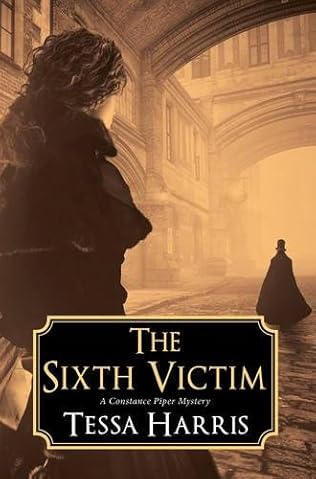
Review of "The Sixth Victim" by Tessa Harris

book cover of 

The Sixth Victim

Release Date: May 30, 2016
Publisher: Kensington Books
Pages: 304
Buy the book from Amazon - https://www.amazon.com/Sixth-Victim-Constance-Piper-Mystery/dp/1496706544/ref=sr_1_1?ie=UTF8&qid=1496189904&sr=8-1&keywords=tessa+harris

The Whitechapel district of London’s East End in the latter decades of the 19th century was a popular place for immigrants and the poor working class. During the late summer and fall of 1888 its foggy lanes became the nighttime hunting ground of one of history’s most notorious serial killers, Jack the Ripper. No woman was safe.

“There’s blood in the air. Again. They’ve got the scent of it in their nostrils and they’re following it, like wolves honing in for the kill. Only the killing’s already done. It’s the third in a month here, in Whitechapel, and the second in little more than a week and everyone’s in a panic.”

Flower girl Constance Piper is not immune to dread, but she is more preoccupied with her own strange experiences of late. Clairvoyants seem to be everywhere these days. But are such powers real? And could Constance really be possessed of second sight? She longs for the wise counsel of her mentor and champion of the poor, Emily Tindall, but the kind missionary has gone missing.

Following the latest grisly discovery, Constance is contacted by a high-born lady of means who fears the victim may be her missing sister. She implores Constance to use her clairvoyance to help solve the crime, which the press is calling "the Whitechapel Mystery," attributing the murder to Jack the Ripper. As Constance becomes embroiled in intrigue far more sinister than she could have imagined, assistance comes in a startling manner that profoundly challenges her assumptions about the nature of reality. She'll need all the help she can get—because there may be more than one depraved killer out there.

Tessa Harris is the acclaimed author of the Dr. Thomas Silkstone Mysteries, which includes Secrets in the Stones and The Anatomist’s Apprentice. In her new novel, The Sixth Victim, Harris delves into “Ripper” lore with the first rendering of the Constance Piper Mystery series.

The novel is set in 1888 as Jack the Ripper has just begun his reign of terror. The storyline alternates between two perspectives, Constance’s and Emily’s. Constance lives in Whitechapel and comes from a poor family; she and her sister make money by stealing from the rich. Emily Tindall is from a good background; she is a Sunday school teacher and has taken Constance under her wing, teaching her to read and showing her a life far removed from her own.

Although The Sixth Victim shadows the murders of Jack the Ripper, the main story is Constance’s search for Emily who seems to have gone missing and how her psychic abilities slowly, and much to her astonishment, grow. Constance is also approached by a lady from the upper classes who fears her sister has been victim of the “Ripper.” The lady asks for Constance’s help in solving the mystery.

With The Sixth Victim, Harris has managed to create a very colorful and sometimes horrifying image of Whitechapel, showing a stark distinction between the lives of the less-fortunate residents of London’s East End to that of the more well-to-do who live in the grand houses and hotels of London. It was easy to imagine the sights and sounds of the area and understand why the women of that time lived in constant fear.

“This may be swanky Piccadilly, where the ladies and gents dress up to the nines, and it could be a million miles away from Whitechapel, but still heart’s beating twenty to the dozen and my mouth’s dry as sandpaper. Bold as brass they were, all cocky and brave. And they can be, ’cos they’re not the ones he’s after. He’s after girls and women who work on the streets. The ones who are out at night, drinking their gin by the gill, so they don’t feel the pain as much; so they don’t have to think on what they’ve become.”

In the Author’s Notes at the beginning of the novel, Harris admits that she is not an expert in “Ripperology” and readily concedes to being an amateur in the field of Jack the Ripper studies. She also states that she has “no wish to contribute to any debate as to the identity of the killer, or killers, in Whitechapel of the late 1800s.” She declares that her purpose in writing this book was “purely to explore the grisly episodes in a fictitious context.”

Overall, The Sixth Victim is well written and will most definitely satisfy readers who enjoy historical fiction and murder mystery. Be warned, if you aren’t into gory descriptions of Ripper style murders this probably isn’t the book for you.

In general, the characters have significant layers of complexity and humor. They are well formed and realistic, and the plot comes together in a logical manner. Constance, the main character, is courageous, moral, curious, and keen to better herself. She’s an amateur sleuth with psychic capabilities who has lots of potential to carry the series forward.

Tuesday, May 16, 2017

Review of "The Scholl Case: The Deadly End of a Marriage" by Anja Reich-Osang

The Scholl Case

Author: Anja Reich-Osang
Release Date: May 16, 2017
Publisher: Text Publishing
Pages: 208

In December 2011, a corpse was found in a forested area near Ludwigsfelde, a tiny and quiet village south of Berlin, Germany. The body was hidden between pine trees and covered with leaves. The victim was Brigitte Scholl, the 67-year-old wife of Ludwigsfelde’s former mayor. Three weeks later, the police arrested and charged the victim’s husband Heinrich Scholl with murder. On the surface, the Scholls appeared to be happy, but behind closed doors there were many secrets.

In 2012, Heinrich Scholl was found guilty of his wife’s murder and sentenced to life in prison. Yet to friends and neighbors this was a shock. How could this soft spoken and well respected man have committed such a heinous act? He had been one of the most successful mayors of East Germany after the fall of the Berlin Wall.

Award winning author and journalist Anja Reich-Osang followed the trial and was given unprecedented access to Heinrich Scholl. In her new book, The Scholl Case: The Deadly End of a Marriage, she attempts to delve into the minds of the Scholls.

Reich-Osang writes, “Heinrich Scholl had assembled trucks in Ludwigsfelde automobile works and made chairs for East Germany’s state circus. When the wall fell, he became involved in local politics, helping to found social democracy in Brandenburg, and was soon one of the most successful politicians of the new federal states. Like the country, he reinvented himself. His life seemed symbolic . . . But what price did he pay for his ascent? What temptations did he withstand . . . ?” And what had happened to his marriage in the almost twenty years in which he transformed Ludwigsfelde into a flourishing place of business?”

The Scholl Case is a terribly sad story that outlines the anguishes of an unhappy marriage. The history of their 40-plus year marriage is told as bluntly as possible, partly because the author is intent on uncovering the facts. She peels back the layers of deception covering the couple’s seemingly normal life and reveals not merely who committed the crime, but the more intriguing question of why the crime was committed.

But there’s a paradox at the center of The Scholl Case. The author seems to respond to the story with disappointment, and her lackluster dramatization of the details of the murder seems to generate only a sense of wonder from the author. Because she is not able to articulate her own feelings about the case, the story takes on an air of diluted lameness.

In the end, The Scholl Case is a sordid tale of sex, lies, politics, and a marriage in which nothing was as it appeared. It is most certainly not a typical true crime book and whether or not it can be truly labeled as nonfiction is debatable. This could be due to its translation; it is more a mixture between historical fiction and crime thriller, although the main focus is on the history of both the mayor and his wife rather than the murder case. Reich-Osang makes no judgment on his guilt or innocence and this leaves the reader to come to their own conclusions.

Despite these minor flaws The Scholl Case is well written and a worthwhile read. It will most certainly satisfy those readers who enjoy the combination of the psychology of marriage and true crime.

Tuesday, May 9, 2017

Review of "The Girl Who Knew Too Much" by Amanda Quick


Anna Harris is the private secretary to wealthy New York socialite, Helen Spencer and for the past year has lived a fast paced life filled with glitter and glamour. This lifestyle is horrifyingly shattered when she stumbles upon the body of her boss, who has been brutally stabbed to death.

“There was blood everywhere in the elegant, white-on-white boudoir. It soaked the dead women’s silver satin evening gown and the carpet beneath her body.”

A menacing warning, “Run,” has been written with victim’s own blood on the wall, and in that moment she knows that the idyllic life she has been living was a deception. Fleeing the scene, she drives across country to Los Angeles, where she attempts to find peace and security. She changes her name to Irene Glasson, which she thinks has a “Hollywood ring to it” and accepts a position as a cub reporter at Whispers, a small tabloid newspaper.

Her quiet life is shattered when murder follows her west. A hot lead about a lured affair between up-and-coming actor, Nick Tremayne and starlet Gloria Maitland takes Irene to the lavish and private Burning Cove Hotel, 100 miles north of Los Angeles.

Arriving for the midnight appointment, Irene finds her source, Gloria Maitland, dead at the bottom of a pool. Once again she finds herself fleeing the scene of a murder, but this time Irene is determined to prove the drowning was not an accident. She partners with Oliver Ward, formerly a famous magician and now the mysterious owner of the hotel to discover why this woman may have been silenced. Seeking the truth, they both soon learn that the glamorous paradise hides dark and dangerous secrets.
“And that past, always just out of sight, could drag them both down.”

Amanda Quick (Jayne Ann Krentz, who also writes as Jayne Castle), has written more than 50 New York Times bestselling novels. In her newest release, The Girl Who Knew Too Much, Quick transports readers back to the golden age of Hollywood and through clever plot twists unmasks the gritty realities that hide behind tinsel town’s glitzy facades.

The Girl Who Knew Too Much is a solid murder mystery, although not one of Quick’s best efforts. It is ripe with details and dialogue. Its short chapters accelerate the story forward at breakneck speed. Main protagonists, Irene and Oliver, are amiable but aren’t easy to attach to. Both are complex characters, so it takes some time to get to know each of them. There are several confusing storylines and trying to keep track of it all is not always easy. Some of the villains you know right away and some are surprising.

Nonetheless, The Girl Who Knew Too Much is a fun, spunky, read that contains plenty of simmering sexual chemistry, which will most definitely satiate the most ardent fans of Amanda Quick. Although it’s a little bit anti-climactic once it’s over, lovers of romantic historical murder mysteries will enjoy the suspense, characters, and atmosphere of old Hollywood.

Tuesday, April 4, 2017

Review of "Convicting Avery" by Michael D, Cicchini


The review first appeared at the New York Journal of Books on April 3, 2017 - http://www.nyjournalofbooks.com/book-review/convicting-avery-bizarre-laws-and-broken-system-behind-making-murderer

Buy the book from Amazon through the following link - https://www.amazon.com/Convicting-Avery-Bizarre-Broken-Murderer/dp/1633882551/ref=sr_1_1?ie=UTF8&qid=1491347433&sr=8-1&keywords=convicting+avery

In 2015 Netflix released the controversial documentary Making a Murderer, which explored the story of Steven Avery, a man from Manitowoc County, Wisconsin, who spent nearly two decades in jail for the rape of Penny Beerntsen, before being cleared by DNA evidence in 2003. After his release he sued the Manitowoc County sheriff’s department for wrongful conviction but was arrested in 2005 on charges of murdering Teresa Halbach, a local photographer.

“For every piece of evidence that initially pointed to guilt. Avery’s defense team presented conflicting evidence and also exposed law enforcement’s motives, inconsistent stories, and, at the very minimum, incredibly shoddy investigative work.”

In 2007, Steven Avery was convicted and sentenced to life in prison without the possibility of parole. In Convicting Avery: The Bizarre Laws and Broken System Behind “Making a Murderer,” author Michael D. Cicchini dissects the tangled legal procedures and sketchy evidence that was used to convict Steven Avery and Brendan Dassey. The author himself is a criminal defense attorney in Wisconsin, blogger, and author of several legal books that includes Tried and Convicted: How Police, Prosecutors, and Judges Destroy Our Constitutional Rights (2012). He is also a contributing columnist for the Wisconsin Law Journal.

At the beginning of Chapter two Cicchini writes, “When I first opened my criminal defense practice . . . I started with a naïve belief that trial judges would be wary of wrongfully convicting an innocent defendant . . . but after a few months of practicing law, I completely abandoned my unfounded beliefs and stood corrected.”

By scrutinizing key evidence in the Avery case such as tainted physical evidence, dubious witness testimony, and illegal police searches, Cicchini skillfully examines and explains the legal how’s and why’s of these controversial convictions. He successfully uses the Avery case to highlight police misconduct and the obviously broken Wisconsin legal system while convincingly demonstrating that the injustices perpetrated against Avery and others were not an unusual occurrence. Cicchini writes, “Wisconsin loves its massive, draconian, ever-expanding, and increasingly irrational criminal justice industrial complex.”

Convicting Avery will most definitely captivate fans of the documentary, and while Cicchini had no direct involvement in the Avery case, this book adds expert legal depth to the key procedural and evidentiary issues that were raised in the original documentary. It provides a rare glimpse inside the complex American criminal justice system.

Although this book certainly assumes that the reader is acquainted with the Making a Murderer documentary, the author’s writing style and concise analysis allows those not familiar with legal terminology to easily comprehend the complexities of the case.

Overall, Convicting Avery is a revealing and fascinating read that will interest readers of true crime, criminal law, or American legal procedures. It will most certainly stimulate further discussions of how someone can be railroaded and falsely convicted of a crime. But regardless of your position on Steven Avery's guilt or innocence, the content of this book raises important concerns about a clearly broken legal system.

Friday, March 31, 2017

Review of "The Ambulance Drivers" by James McGrath Morris


This review first appeared at the New York Journal of Books on March 27, 2017 http://www.nyjournalofbooks.com/book-review/ambulance-drivers


“Paris represented everything their homeland was not for the generation of Americans writers like Hemingway and Dos Passos who had come of age during the Great War. An incomprehensible number of men, more than 9 million, had been killed, and twice that number had been maimed. It seemed to these young aspiring writers . . .the world was no longer the same and never would be again.”

John Dos Passos and Ernest Hemingway initially crossed paths in 1918 as ambulance drivers in war torn Italy. The two literary icons would met again in the early 1920s in the American expatriate society of Paris where the allure of the city had seduced many writers, artists, and composers. By this time, Dos Passos was already an established author and highly respected, while Hemingway was still an up and comer on the brink of greatness. Throughout the 1920s and better part of the 1930s they were best of friends and honest critics of each other’s works.

“John Dos Passos was one of the few people at certain times whom Ernest could really talk to” and “Their nascent friendship rose out of a unique common bond . . . they dreamed of penning the great books of their generation. They were almost alone among American writers of their age in having witnessed the war that defined their generation.”

Although these two former Chicagoans had many things in common on the surface, they were complete opposites as far as philosophy and temperament. Hemingway was arrogant, certain of himself, willing to get ahead at the expense of others, and athletic. Dos Passos was well educated, timid, considerate to a fault, and not an athlete.

By the mid-1930s, their relationship began to deteriorate. Hemingway became more obsessive about his writing and even more self-centered in his relationships. Dos Passos, who was busy with his own writing was inattentive to Hemingway. The latter’s egoistical selfishness to friends was worsened by his almost total lack of social awareness, his preoccupation with the horrors of war, and his own self-destructive psychoses.

Tiny incidents accumulated to an intolerable level, at least in Hemingway’s mind, and he began to lash out at his baffled friend. The ultimate breaking point, however, came in 1937, during the Spanish Civil War. Hemingway and Dos Passos were in Spain, when José Robles a patriot in the leftist Popular Front and good friend of Dos Passos disappeared under mysterious circumstances. The Hemingway-Dos Passos relationship finally reached its endgame on April 22, 1937, when Hemingway, brimming with confidence and cruelty, told Dos Passos that Robles had been shot as a proven fascist collaborator, a renegade, a dirty spy, a betrayer of his friends. Dos Passos was left shocked and devastated. Their friendship never recovered.

James McGrath Morris, the author of several critically acclaimed biographies, including the New York Times bestselling Eye on the Struggle and Pulitzer delves head first into the mercurial relationship of these two American literary legends in his new book, The Ambulance Drivers: Hemingway, Dos Passos, and a Friendship Made and Lost in War.

Throughout this riveting biography Morris expertly narrates the journeys, relationships, and life-changing events that inspired two of the greatest authors of the 20th century. While Hemingway believed that literature should be a perfect representation of an imperfect world, Dos Passos wanted his writing to change the world. Both versions played a significant role in shaping what would become the voice of the Lost Generation.

The Ambulance Drivers is a lively and engaging biography that takes a fresh look at the life of Dos Passos, but fails to shed any new light into Hemingway, whose life has already been well documented. Although readers may at first hesitate to embark on yet another analysis of Ernest Hemingway, Morris’ framing of the context of his fragile and contemptuous relationship with fellow literary giant John Dos Passos creates a worthwhile read. It will most certainly fascinate Dos Passos and Hemingway aficionados, as well as the casual literary biography enthusiast.

Michael Thomas Barry is the author of seven nonfiction books that includes America’s Literary Legends: The Lives & Burial Places of 50 Great Writers.


Monday, March 6, 2017

Review of Murder in Plain English by Michael Arntfield & Marchel Danesi

Murder in Plain English: From Manifestos to Memes--Looking at Murder through the Words of Killers

The review first appeared at the New York Journal of Books on March 6, 2017 http://www.nyjournalofbooks.com/book-review/murder-plain-english

Buy the book through Amazon - https://www.amazon.com/Murder-Plain-English-Manifestos-Memes-Looking/dp/1633882535/ref=sr_1_1?ie=UTF8&qid=1488840796&sr=8-1&keywords=murder+in+plain+english

“Humans are the planet’s outliers when it comes to murder. We are, needless to say, also the only species that has the ability to document our experiences associated with murder through the written word.”

Why are we as a society so obsessed with crime? Our fascination with murder in particular has led to the writing of countless volumes of books which have further stoked the insatiable need to know as much as possible about these heinous acts as possible. Is there a link between murder and literature? And how can we use the writings of killers to identify them, catch them, and stop them? Murder in Plain English: From Manifestos to Memes—Looking at Murder through the Words of Killers, co-authored by Michael Arntfield, a professor of criminology at Western University and Marcel Danesi, a professor of anthropology at the University of Toronto, attempt to answer this unique and thought provoking question.

“The first book to examine murder through the written word, not only the writings of the killers themselves, but also the story of murder as told in literary fiction and crime dramas that are now a staple of film and television. Based on extensive research and interviews with convicted murderers, the book emphasizes the often-overlooked narrative impulse that drives killers, explaining how both mass and serial murderers perceive their crimes as stories and why a select few are compelled to commit these stories to writing whether before, during or after their horrific acts.”

Arntfield and Danesi call their tantalizing theory, “literary criminology,” the study of crime through literature and language. In this book they attempt to “penetrate the raison d'être of murder, through two sets of eyes, those of the literary writer and those of the murderer-as-writer.”

Early on in the text the authors make an astounding statement that they believe “countless deranged killers . . . were failed writers of one kind or another,” and further state, “literary genius . . . is rather common. Mass murderers, terrorists, and serial killers alike, regardless of education or literary level, demonstrate a consistent narrative impulse to both document and rationalize their grisly crimes.” Although part of this statement is true, they never fully backed up the murderer as “literary genius” claim with any evidence.

Murder in Plain English includes an extraordinary large and impressive collection of murderers and their foul deeds, both well-known and obscure. Be warned this is not a book for the faint of heart and is explicit in its descriptions. Unfortunately, the sheer number of stories, its rambling disjointed nature, and academic writing style makes for a difficult and often unpleasant read.

While the books premise is extraordinarily unique, the author’s obvious bias and often forced inferences on the evidence, instead of reasoning from facts to conclusions leave the reader confused. Despite all the specifics, analysis, and provocative nature of the subject matter there is no greater understanding of the reasons why people commit murder. The mere statements of killers and madmen, whether in written confessions, letters, diary entries, manifestos, or memes cannot be considered literature and any attempt at connecting the two is a stretch beyond the point of reason. In the words of the authors themselves “This linkage between writing and murder has undergone very little expert scrutiny or analysis,” and to be honest there’s a reason for that.